


Downward communication is the flow of information from organizational leadership to employees through established hierarchical channels. You’ll learn what downward communication is, why organizations depend on it, how to choose the right channel for your message, and how to prevent the information distortion that often undermines top-down messaging.
What is downward communication?
Downward communication moves information from higher organizational levels to lower ones. When a CEO announces a new strategic direction to vice presidents, when managers assign tasks to their teams, or when HR sends a policy update to all employees, that’s downward communication in action.
This flow follows the organizational hierarchy. A message might start with the executive team, move to department heads, then to team leaders, and finally reach frontline employees. Each layer receives information from the level above and often passes it down further.
Downward communication is one of several types of vertical communication that includes upward flows (employees to management) and horizontal flows (peer-to-peer). The distinguishing feature is direction: information originates at a higher authority level and travels down.
The core purpose is alignment. Organizations use downward communication to ensure employees understand goals, follow policies, complete assigned tasks, and receive performance feedback. In a 50-person company, a CEO can speak directly to everyone. In a 5,000-person organization, downward communication through management layers becomes the only practical way to reach everyone consistently.
Why downward communication matters in organizations
Consistent messaging prevents the rumor mill. When leadership doesn’t communicate decisions clearly, employees fill the gap with speculation. A well-executed downward communication system delivers the same core message to all employees, reducing confusion and aligning everyone around shared facts.
Role clarity depends on it. Employees need to know what they’re responsible for, what authority they have, and how their performance will be evaluated. Downward communication establishes these boundaries. A marketing coordinator who receives clear objectives from their manager knows exactly what success looks like. Without that clarity, they’re guessing.
Delegation requires downward channels. When a regional director assigns a project to a district manager, who then assigns tasks to store managers, that’s delegation enabled by downward communication. Each level receives authority and responsibility from the level above. The chain only works when messages flow clearly down the hierarchy.
Organizations with strong downward communication systems show measurably better performance. Research from McKinsey found that companies with connected employees outperform their peers by up to 4.2 times in revenue growth. Clear top-down messaging is part of that connection.
Strategic alignment connects daily work to company mission. When a software developer understands how their code contributes to quarterly revenue goals, they make better priority decisions. Downward communication builds that line of sight from executive strategy to individual task lists.
Common purposes and use cases
Job instructions are the most frequent use case. A warehouse supervisor tells forklift operators which shipment to prioritize. A creative director assigns a designer to a client project with specific deliverables and deadlines. These task assignments flow downward with clear expectations about what to do, how to do it, and when it’s due.
Policy and procedure announcements require formal downward channels. When HR updates the remote work policy, that change must reach every employee consistently. Compliance rules, safety protocols, and operational changes all move through downward communication to ensure uniform understanding and application across the organization.
Performance feedback travels downward.
Annual reviews, quarterly check-ins, and real-time coaching all involve a manager communicating evaluation results and improvement areas to employees. Recognition for strong performance also flows down this channel, reinforcing desired behaviors. Strategic alignment messages connect employee work to bigger goals. A CEO’s quarterly town hall explaining market conditions and company priorities is downward communication. So is a department head’s email linking team projects to the annual strategic plan. These messages answer the “why are we doing this?” question that keeps employees engaged.
Training and onboarding rely on downward communication. New employee orientation, system training sessions, and skill development programs all involve information flowing from trainers or managers to learners. The objectives of downward communication in these contexts include knowledge transfer, skill building, and cultural integration.
Choosing the right communication channel
Email and memos work best for documented, non-urgent messages. Policy updates, meeting recaps, and procedural changes fit this channel. The written record creates accountability and gives employees a reference to return to later. Use email when you need a paper trail and when the message doesn’t require immediate action or dialogue.
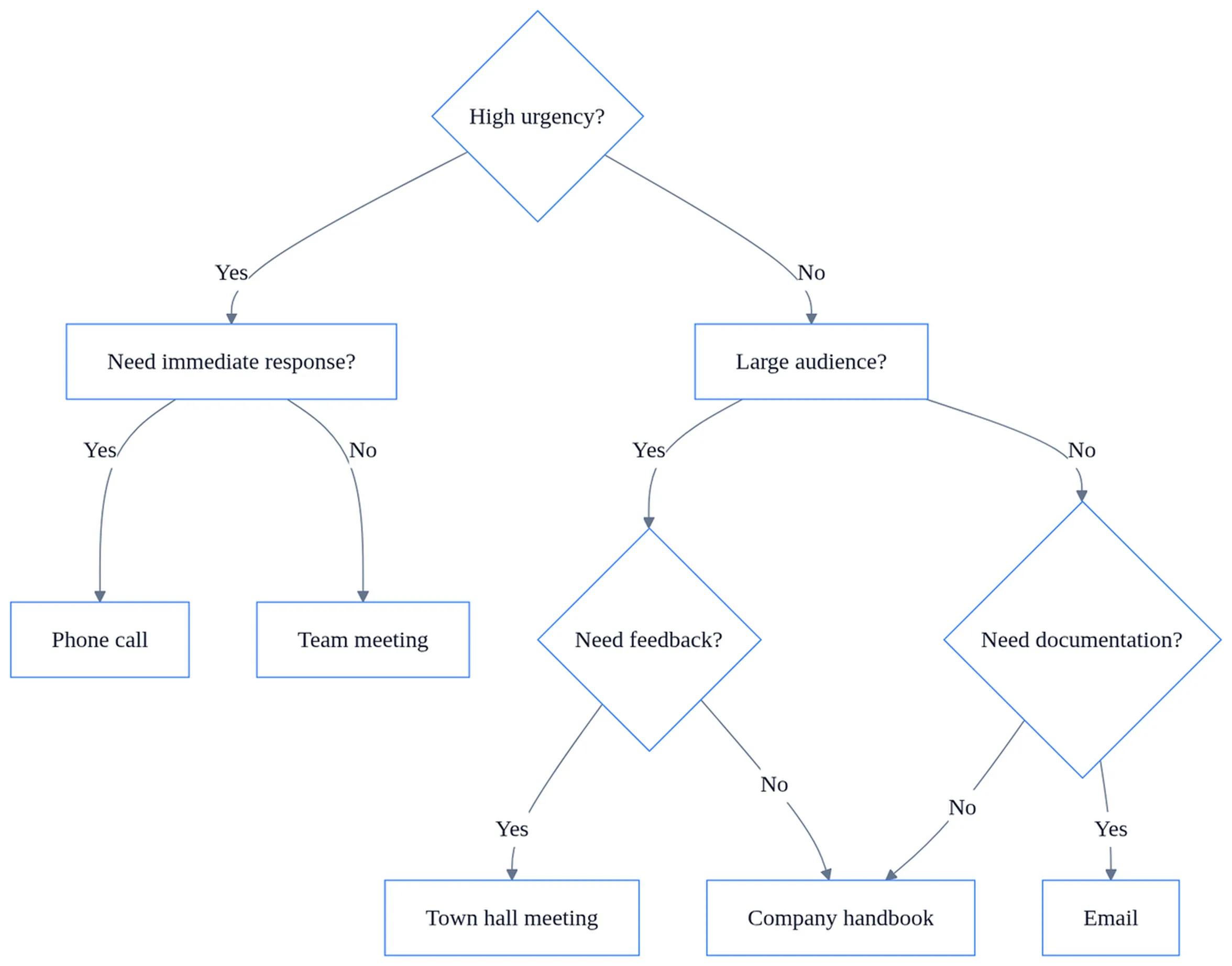
Face-to-face meetings handle complex information better than any written channel. Strategic announcements, organizational changes, and feedback requiring discussion all benefit from in-person delivery. You can read body language, answer questions in real time, and adjust your message based on audience reaction. Reserve meetings for high-stakes messages where dialogue adds value.
Phone calls suit urgent, one-on-one communication. When a manager needs to deliver sensitive feedback or clarify a misunderstood instruction immediately, a phone call beats email. The synchronous nature allows for quick back-and-forth without the formality of scheduling a meeting.
Town halls and video addresses reach large audiences with consistent messaging. A CEO announcing a merger or a department head explaining restructuring can speak to hundreds or thousands of employees simultaneously. Video works especially well for distributed teams who can’t gather in one location.
Handbooks and manuals serve as ongoing reference materials. Employee handbooks, standard operating procedures, and compliance guides are downward communication tools employees consult repeatedly. They complement real-time communication by providing detailed information that doesn’t fit in an email or meeting.
The right channel depends on four factors: urgency, audience size, feedback need, and documentation requirement. High urgency with small audience? Phone call. Large audience needing documentation? Email. Complex message requiring dialogue? Meeting. Most teams over-rely on email because it feels efficient, but that backfires when the message needs real-time clarification or when tone matters more than a written record can convey.
| Channel | Best for | Urgency | Audience size | Feedback loop |
|---|---|---|---|---|
| Email/Memo | Policy updates, documented instructions | Low to medium | Any size | Limited |
| Face-to-face meeting | Complex decisions, strategic changes | Medium to high | Small to medium | High |
| Phone call | Urgent clarification, sensitive feedback | High | Individual | High |
| Town hall/Video | Company-wide announcements, CEO messages | Medium | Large | Medium |
| Handbook/Manual | Reference materials, ongoing procedures | Low | Any size | None |
For a comprehensive look at channel options, see our guide to methods of internal communication.
The information distortion problem and how to prevent it
Messages change as they cascade through organizational layers. The telephone game you played as a child happens in businesses every day. A CEO announces a strategic shift to vice presidents, who explain it to directors, who brief managers, who tell frontline employees. By the fifth layer, the message often bears little resemblance to the original.
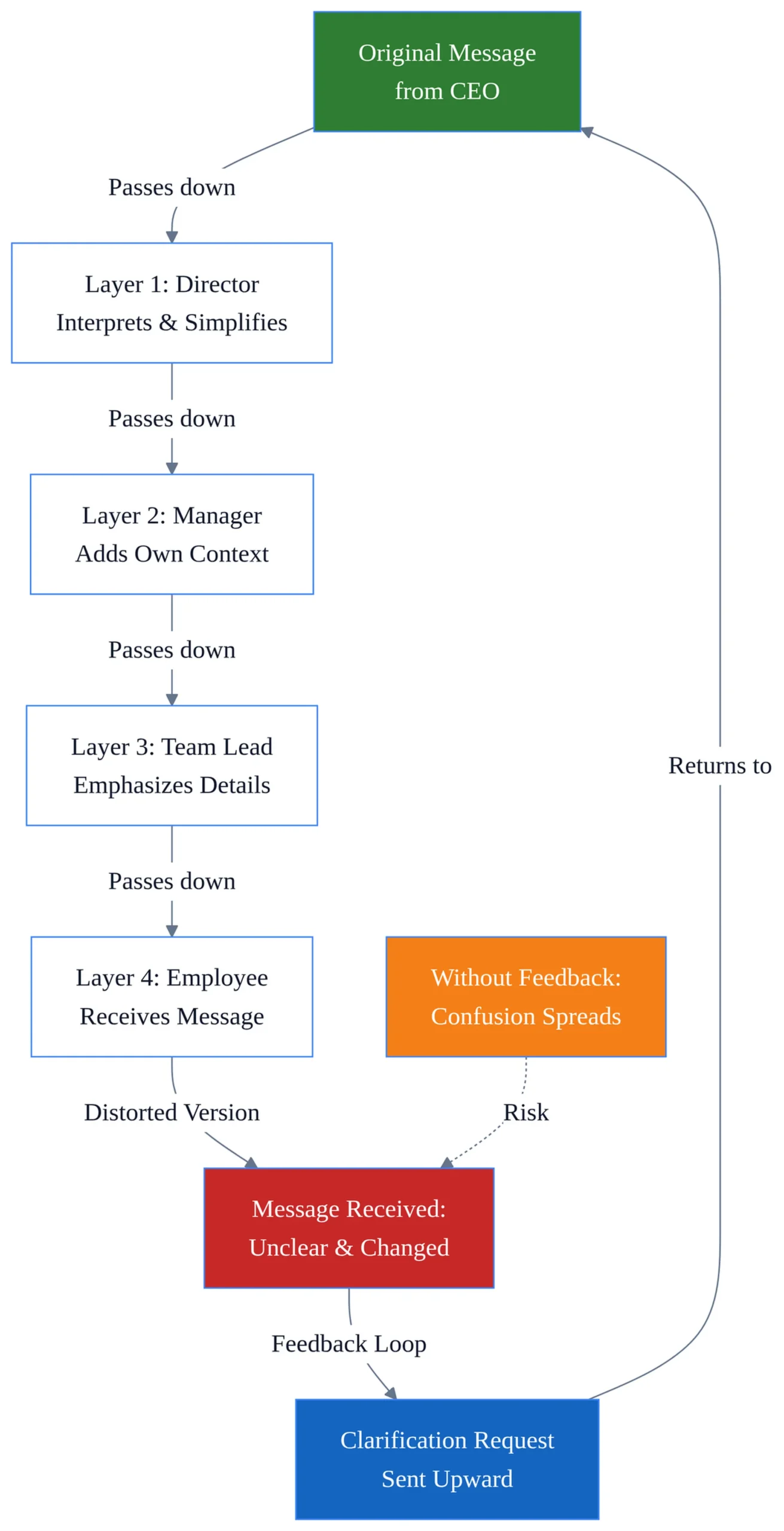
Each relay point introduces distortion. Managers filter information based on what they think employees need to know. They add their own interpretation. They forget details. They highlight different points. A nuanced strategic message becomes oversimplified or, worse, contradictory by the time it reaches the bottom of the hierarchy.
Lack of feedback loops prevents leaders from catching distortion. The CEO who announces a change rarely hears how frontline employees understood it. Without verification mechanisms, leadership operates under the false assumption that their message landed intact. Meanwhile, employees act on a garbled version, creating execution problems that leadership can’t trace back to communication failure.
Extended timelines delay critical messages. When a time-sensitive announcement must pass through five management meetings before reaching frontline staff, days or weeks can elapse. By the time employees hear the news, it may be outdated or they may have already heard distorted versions through informal channels.
Multi-channel repetition reduces distortion. Send the message through email, discuss it in meetings, and post it on internal platforms. When employees receive the same core message through different channels, the consistent elements reinforce accuracy and the variations become obvious.
Direct leadership involvement for high-stakes messages bypasses distortion points. A CEO who records a video message for all employees eliminates the relay-point problem. Every employee hears the same words in the same tone. Town halls, all-hands emails, and recorded addresses give leadership a direct line to every level.
Built-in feedback mechanisms verify message receipt and comprehension. Follow strategic announcements with pulse surveys asking employees what they understood. Hold Q&A sessions where employees can ask clarifying questions. Create anonymous feedback channels where employees can report confusion without fear. These loops close the gap between message sent and message received.
Skip-level communication reveals distortion in middle management. When senior leaders periodically meet with employees two or three levels below them, they hear how messages are landing without the filter of intermediate managers. A director who speaks directly with frontline staff often discovers that their carefully crafted strategy communication got lost in translation by middle management.
Balancing authority with two-way dialogue
Directive-only downward communication creates disengagement. When employees only receive orders without opportunities to provide input, they feel like cogs in a machine. Engagement drops. Turnover rises. The best employees leave for organizations that value their perspective.
A small Dhaka-based marketing agency learned this the hard way. The founder issued detailed instructions for every client project, leaving no room for creative input from designers and copywriters. Within six months, three senior creatives quit. Exit interviews revealed the same complaint: “My expertise doesn’t matter here.” The founder shifted to providing project objectives and client requirements while inviting team input on execution. Retention improved immediately.
Micromanagement perception damages trust. When every downward message is a prescriptive instruction with no room for employee judgment, capable employees feel mistrusted. They stop thinking critically about their work because leadership has already made every decision for them. Organizational learning stalls.
Employee expertise gets overlooked. Frontline employees often know operational realities that leadership doesn’t see. A warehouse manager who only receives instructions without being asked for input can’t share that the new inventory system creates bottlenecks. That knowledge stays trapped at the bottom of the hierarchy.
Feedback loops make employees feel heard. Open Q&A sessions after major announcements, pulse surveys following policy changes, and manager-led discussion sessions all create space for employee voice. The simple act of asking “What questions do you have?” or “How will this affect your work?” transforms one-way broadcasting into dialogue.
Leaders gain real-time insight into message comprehension. When a CFO announces budget cuts and immediately opens the floor for questions, she discovers which parts of her message confused people. She can clarify on the spot instead of letting misunderstanding fester for weeks.
Anonymous feedback channels surface resistance. Employees hesitate to challenge leadership decisions in public forums. Anonymous surveys, suggestion boxes, and third-party feedback tools let employees share honest reactions without career risk. Leadership learns what’s really happening instead of what people are willing to say in meetings.
The hybrid approach works best: clear top-down direction paired with invitation for employee input on implementation. Leadership sets the “what” and “why.” Employees contribute to the “how.” A retail chain rolling out a new customer service protocol might mandate the core requirements while asking store managers how to adapt the approach for their specific customer demographics. This balance maintains authority while tapping into distributed expertise. For more on balancing directive communication with engagement, see our article on how to make downward communication effective.
Downward communication in hybrid and remote workplaces
Asynchronous work patterns challenge real-time downward communication. When your team spans three time zones, a 10am announcement reaches some employees during work hours, others at lunch, and others after they’ve logged off. Synchronous town halls exclude someone. The solution is multi-modal delivery: live meeting for those available, plus recorded video, written summary, and FAQ document for everyone else.

Digital noise drowns out important messages. Research from SHRM shows employees receive an average of 153 messages daily across email, chat, and collaboration platforms. Your carefully crafted policy announcement competes with 152 other messages for attention. Downward communication in this environment requires intentional signal boosting: clear subject lines, prominent platform placement, and follow-up reminders.
Distributed teams miss informal information flow. In a physical office, important messages spread through hallway conversations and overheard discussions. Remote employees don’t get those informal reinforcements. What an in-office employee hears three times through different channels, a remote employee might only see in one email they skim while multitasking. Deliberate redundancy becomes necessary.
The best practice combines synchronous and asynchronous channels. Announce a major organizational change in a live town hall where employees can ask questions. Record that town hall and post it to your intranet. Send an email summary highlighting key points. Create a FAQ document addressing common questions. Open an async discussion thread for ongoing questions. This layered approach ensures maximum reach and comprehension regardless of when or where employees work.
A multinational software company with teams in Bangladesh, India, and the United States uses this approach for product launches. The product VP hosts a live kickoff meeting at a time that works for US and Indian teams. The session is recorded for the Bangladesh team to watch during their work hours. A written brief goes to all teams simultaneously. A Slack channel stays open for questions across all time zones. No one misses critical information because of their location.
Measuring downward communication success
Message received is not the same as message understood. You can track email open rates and meeting attendance, but those metrics don’t tell you if employees comprehended your message or if it changed their behavior. Real measurement goes deeper.
Comprehension assessment verifies understanding. After announcing a new safety protocol, quiz employees on the key requirements. After explaining a strategic shift, ask managers to describe the change in their own words. Low comprehension scores reveal that your message didn’t land, even if everyone attended the meeting where you delivered it.
Behavioral compliance shows whether employees act on downward communication. If you announce a new approval process and employees keep using the old one, your communication failed regardless of how many people read your email. Track actual behavior change, not just message exposure.
Engagement metrics reveal how employees receive your message. Pulse survey responses, Q&A participation rates, and feedback loop completion rates all indicate whether employees care about what you’re communicating. Low engagement suggests your messages feel irrelevant or that employees don’t trust the communication channel.
Retention measures long-term impact. Do employees remember your message two weeks later? A month later? If you communicated new company values and employees can’t recall them a month later, the communication didn’t stick. Periodic spot checks reveal whether important messages became part of organizational knowledge or evaporated immediately.
Business outcomes provide the ultimate measure. Does clear downward communication correlate with productivity, retention, and compliance rates in your organization? Companies that track communication quality alongside business metrics often find strong correlations. Teams with high communication scores show lower turnover and higher productivity.
Red flags signal communication breakdown. High message distortion between management levels, low feedback participation, widespread employee confusion about policies or goals, and delayed task execution all point to downward communication failures. These symptoms require diagnosis and intervention, not just more messaging.
The effectiveness of downward communication depends on measurement and iteration. Organizations that track these metrics and adjust their approach based on results build stronger communication systems over time.
Downward communication is essential infrastructure for organizational alignment, but it requires deliberate design. Choose channels that match your message type and urgency. Build feedback loops to prevent information distortion. Balance directive authority with space for employee input. Layer synchronous and asynchronous delivery for hybrid teams. Measure comprehension and behavior change, not just message delivery. The essential elements of downward communication and the advantages and disadvantages of downward communication both matter less than your execution. A well-designed downward communication system reaches every employee with clarity, invites their perspective, and drives the behaviors that organizational success requires.
Frequently asked questions
Should I announce a major policy change via email or in a meeting?
Use a meeting for the initial announcement so you can explain the reasoning, answer questions, and gauge employee reaction. Follow up with a detailed email that employees can reference later. This combination ensures understanding and creates the documentation you need for compliance.
What if my message gets distorted as it passes through multiple management layers?
Provide written talking points or a memo that managers must share verbatim with their teams. Schedule cascade meetings where each level briefs the next, and ask managers to confirm understanding before they communicate downward. Spot-check by asking frontline employees to repeat back the core message.
Is it appropriate to skip levels and communicate directly with lower-level employees?
Avoid bypassing your direct reports regularly—it undermines their authority and creates confusion about who owns what. For company-wide announcements (strategy, major policy), direct communication from leadership is appropriate. For operational decisions, always go through the chain of command.
How do I know if my downward communication is actually working?
Ask employees to summarize key messages back to you in surveys or one-on-ones. Track whether they follow new procedures correctly and meet deadlines on assigned tasks. Monitor turnover and engagement scores—poor downward communication correlates with lower retention and morale.
Can I use casual tone in downward communication, or must it always be formal?
Match your tone to the message and audience. Policy announcements and performance feedback warrant professionalism. Task assignments and strategic updates can be conversational if your company culture supports it. Consistency matters more than formality—employees should recognize your communication style.
3 Comments
Such a great article. Reading the article from beginning to end was so enlightening. I’m so glad this came up. Knowledge is power.
Could you please add some examples of downward communication.
Thank you so much it was so helpful and well explained