


We live in a world of instant communication. You can send a message on Slack, shoot a quick email, or even drop a text to a colleague. With all these fast options available, you might wonder why companies still bother with formal memos. It feels a bit old-school, doesn’t it?
However, the memo is far from dead. In fact, it remains one of the most powerful tools in business communication. When you need to be taken seriously, a text message just won’t cut it. Memos carry a weight of authority that other channels often lack. They serve as the official voice of management.
Still, like any tool, memos have their flaws. Use them correctly, and they can streamline your operations. Use them poorly, and they can alienate your staff or create confusion.
If you are trying to decide whether to type up a formal document or just walk over to someone’s desk, this guide is for you. We are going to explore the specific pros and cons of using memos. We will look at why they are essential for documentation and where they fall short in building relationships.
Before we dive into the merits and demerits, you should ensure you have a clear grasp of the comprehensive definition of a business memo. Understanding exactly what this document is will help you see why it has such a unique place in the office ecosystem.
The Key Advantages of Memos
Let’s start with the positives. There is a reason why memos have survived for over a century in the corporate world. They offer specific benefits that instant messaging simply cannot match. Here are the main reasons why smart managers still love them.
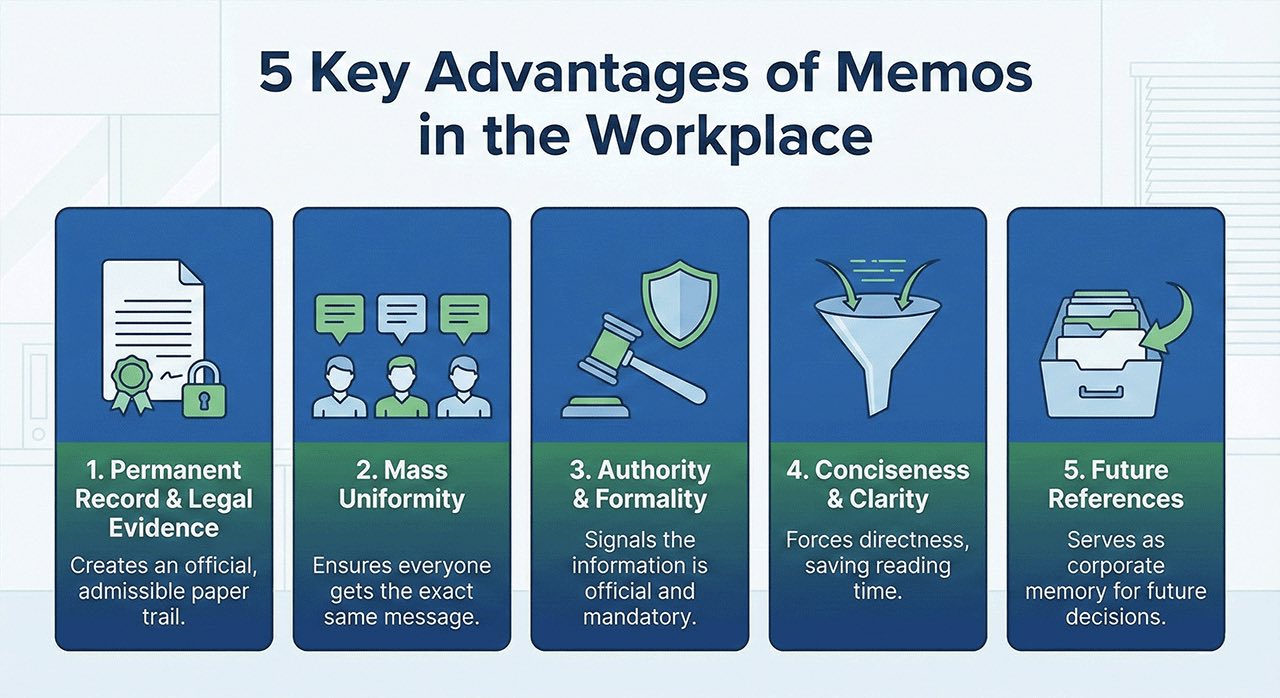
1. Permanent Record and Legal Evidence
The biggest advantage of a memo is that it creates a paper trail. In business, “if it isn’t written down, it didn’t happen.” Verbal instructions are easy to forget or misunderstand. A memo, on the other hand, is permanent.
Imagine a scenario where a manager gives a verbal warning to an employee about being late. Two months later, the employee is late again. The manager tries to fire them, but the employee claims they were never warned. Without proof, the company could be in legal trouble.
If that manager had sent a formal memo, there would be no debate. The document serves as concrete evidence of the communication. This is why specific categories of memos, such as confirmation or disciplinary memos, are so critical for HR departments. They protect the organization.
2. Mass Uniformity
Have you ever played the game “Chinese Whispers” or “Telephone”? You whisper a phrase to one person, they whisper it to the next, and by the time it reaches the last person, the message is completely different.
This happens in offices all the time with oral communication. A CEO tells a manager to cut costs, the manager tells the supervisor to stop buying coffee, and the supervisor tells the team that the company is going bankrupt. Panic ensues.
A memo solves this problem instantly. It ensures mass uniformity. You write one document, and everyone reads the exact same words. There is no room for distortion as the message travels down the chain of command. Regardless of whether you have ten employees or ten thousand, a memo guarantees that everyone is on the same page at the same time.
3. Authority and Formality
Context matters. The medium you choose tells the reader how important the message is. If you invite someone to a meeting via a sticky note, they might think it is optional. If you send a formal memo, they know it is mandatory.
Memos carry an inherent sense of authority. They signal that the information comes from a position of power and requires serious attention. This is particularly useful when announcing policy changes or new rules.
Unlike emails, which can often feel casual or conversational, a memo commands respect. It helps establish a professional distance when necessary. If you are struggling to understand when to be formal and when to be casual, reviewing the comparison between memos and emails can highlight why the memo is the superior choice for serious matters.
4. Conciseness and Clarity
Business professionals are busy. They do not have time to read long, rambling letters. One of the best features of a memo is its structure. It forces the writer to be concise.
The standard format—with its “To,” “From,” and “Subject” headers—encourages a direct approach. You don’t need “Dear Sir” or “Sincerely Yours.” You don’t need to ask about their weekend or the weather. You get straight to the point.
This brevity saves time for both the writer and the reader. It forces you to distill your thoughts down to the essentials. In a fast-paced corporate environment, this efficiency is invaluable.
5. References for Future Decision Making
Memos act as the “corporate memory” of an organization. Employees come and go. Managers get promoted or retire. When new people step into these roles, they need to understand why certain decisions were made in the past.
A well-organized file of memos allows future leaders to look back and understand the history of the company. They can see when a policy was changed and why. They can review the results of past projects.
Without these written records, a company loses its history every time a senior employee leaves. Memos ensure that knowledge stays within the organization, allowing for better strategic planning in the long run.
The Key Disadvantages of Memos
Despite their benefits, memos are not perfect. In fact, relying on them too much can actually harm your office culture. It is important to recognize the limitations of written communication so you don’t fall into common traps.
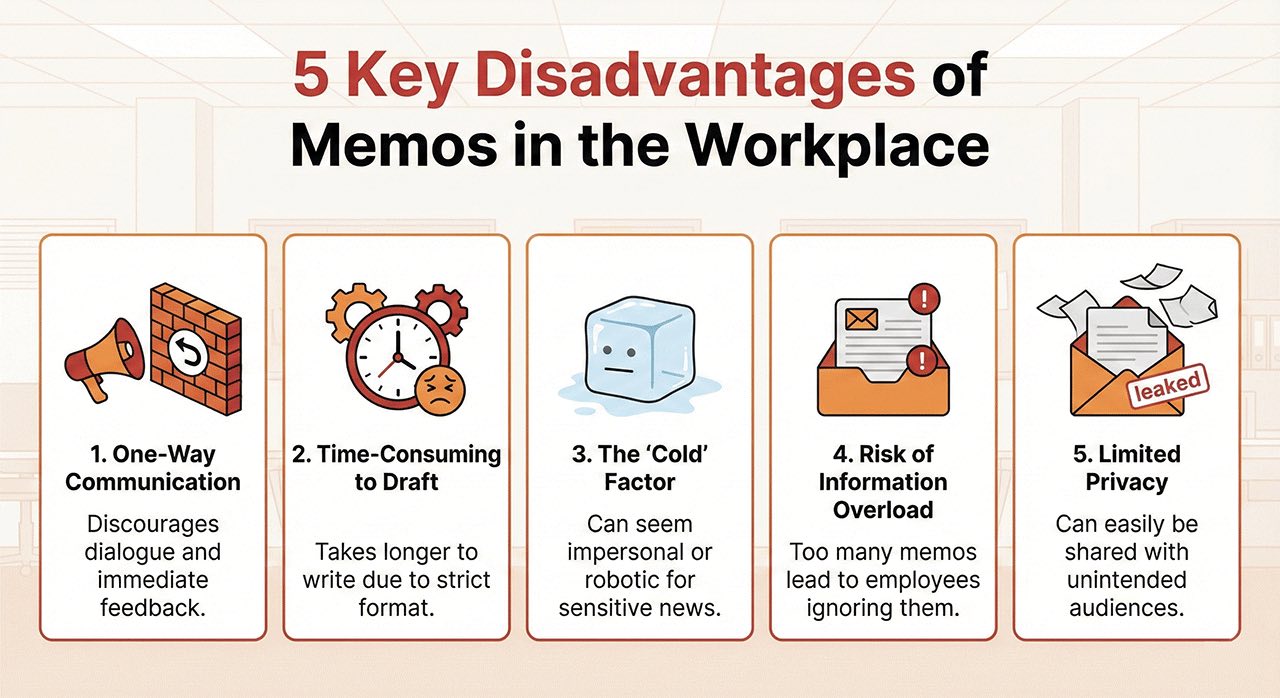
1. One-Way Communication
The most significant drawback of a memo is that it is typically a one-way street. It is a broadcast tool, not a conversation tool. You speak, and the employees listen.
This can be dangerous if you need feedback. Since memos don’t naturally invite a reply, employees might feel like their opinions don’t matter. They might spot a flaw in your plan but feel too intimidated to speak up because the “official memo” has already gone out.
This lack of dialogue can stifle innovation. It creates a culture where management dictates and workers obey, rather than a culture of collaboration. If you need brainstorming or input, a memo is usually the wrong choice.
2. Time-Consuming to Draft
While memos are short, writing a good one takes time. You cannot just dash it off like a text message. You have to worry about the tone, the structure, and the clarity.
Because memos are official records, mistakes are costly. A typo in a policy memo can lead to confusion across the entire company. Therefore, you have to draft, edit, and proofread carefully.
Furthermore, adhering to the strict standard formatting rules can feel tedious. You have to ensure the margins are right, the headings are correct, and the distribution list is accurate. For a busy manager, this administrative burden can be frustrating.
3. The “Cold” Factor
Written words lack emotion. They lack body language, tone of voice, and facial expressions. As a result, memos can often come across as cold, distant, or robotic.
This is a major issue when delivering sensitive news. Imagine getting a memo that says, “Due to budget cuts, the annual bonus is cancelled.” It feels harsh and uncaring. If a manager delivered that same news in person, they could show empathy and answer questions.
Using memos for negative feedback or bad news can damage morale. It makes employees feel like they are just numbers on a spreadsheet rather than valued team members. It creates an emotional distance between management and staff that is hard to bridge.
4. Risk of Information Overload
In some companies, management falls in love with memos. They send a memo for everything. A memo for a lost stapler. A memo for a dirty breakroom. A memo for a new plant in the lobby.
When you send too many memos, you trigger the “Cry Wolf” effect. Employees stop paying attention. They see a new memo in their inbox and immediately delete it or file it away without reading.
This information overload means that when you finally send a truly important memo, nobody reads it. The impact is lost because the channel has been flooded with trivial noise.
5. Limited Privacy
Once a memo is written and distributed, you lose control over it. You might intend for it to be internal only, but it is very easy for a digital memo to be forwarded to people outside the company.
A disgruntled employee could leak a confidential policy change to the press or a competitor. Unlike a face-to-face conversation, which leaves no physical trace, a memo can be copied, printed, and shared instantly.
This risk means you have to be extremely careful about what you write. You should never put anything in a memo that you wouldn’t want to see on the front page of a newspaper. This limitation can make it difficult to communicate about sensitive trade secrets or early-stage plans.
Memo vs. Oral Communication: When to Choose Which?
So, we have seen the pros and cons. The big question now is: when should you use a memo, and when should you just talk?
Making the right choice depends on the complexity of your message and the emotional weight it carries.
You should choose a memo when accuracy is non-negotiable. If you are explaining a complex new health insurance plan, you need a memo. You cannot expect people to remember the details of deductibles and premiums from a verbal conversation.
You should also use a memo when you need to reach a large number of people simultaneously. Gathering 500 employees for a meeting is expensive and logistically difficult. A memo reaches them all in seconds.
On the other hand, you should choose oral communication when the topic is sensitive. If you are firing someone, hiring someone, or critiquing their behavior, do it in person. These situations require human empathy.
Additionally, choose oral communication when you need immediate feedback. If you are trying to solve a problem and don’t know the answer yet, call a meeting. Don’t send a memo proposing a solution until you have discussed it with your team.
Sometimes, managers get confused between memos and other formal documents like notices or circulars. Understanding the difference among circulars, notices, and memos can help you pick the right tool for the specific audience you are trying to reach.
How to Overcome the Disadvantages
Just because memos have disadvantages doesn’t mean you should stop using them. Instead, you should learn how to mitigate the risks. A smart manager knows how to soften the edges of a formal document.
First, you can solve the “one-way communication” problem by explicitly asking for feedback. End your memo with a sentence like, “I welcome your thoughts on this new policy,” or “Please reply to me directly if you have concerns.” This simple addition invites dialogue and makes the staff feel included.
Second, you can combat the “time-consuming” nature of memos by keeping them brief. Do not try to write a novel. Stick to the facts. The shorter the memo, the faster it is to write, and the more likely it is to be read.
Third, you can fix the “cold factor” by paying attention to your tone. A memo doesn’t have to sound like it was written by a robot. You can use polite, professional, and even warm language while maintaining authority.
Using words like “we” and “our” instead of “you” and “must” helps build a sense of teamwork. If you are unsure how to strike this balance, referencing a step-by-step guide on drafting a memo can provide you with practical tips on word choice and tone.
Finally, avoid information overload by being selective. Before you write, ask yourself if this really needs to be a memo. Could it be an email? Could it be a quick mention in the Monday morning meeting? If you save memos for the truly important stuff, people will pay attention when one arrives.
Conclusion
The memo is a double-edged sword. On one side, it offers clarity, legal protection, and authority. It cuts through the noise and ensures that everyone marches to the beat of the same drum. It is the backbone of organizational documentation.
On the other side, it can be slow, impersonal, and stifling. It can create barriers between leaders and their teams if used carelessly.
The key to success isn’t to abandon memos, nor is it to use them for everything. The secret lies in balance. Use memos for policy, for documentation, and for complex information. Use conversation for brainstorming, for feedback, and for bad news.
By understanding the advantages and disadvantages of memos in the workplace, you become a more effective communicator. You learn to wield this tool not just to dictate, but to inform and guide your organization toward success.
So, the next time you sit down to type out that formal header, take a moment to think. Is this the best way to send this message? If the answer is yes, then write it clearly, keep it concise, and hit send with confidence.
Frequently asked questions
When should I send a memo instead of just emailing the team?
Send a memo when you need a formal record, announce mandatory policy changes, or communicate something that requires legal documentation. Use email for routine updates or back-and-forth discussion. If the message needs to be referenced months later or could have legal implications, a memo is the safer choice.
What if employees ignore or don’t read my memo?
Follow up with a brief email summarizing the memo’s key points and directing readers to the full document. You might also mention it in a team meeting. A memo creates a record that the communication happened, but delivery doesn’t guarantee comprehension. Combine it with another channel for important announcements.
Can I use a memo for something that needs two-way discussion?
No. Memos are broadcasts, not conversations. If you need feedback, questions, or dialogue, use email or schedule a meeting instead. A memo works best for announcements, directives, and documentation. If you force a memo into a discussion scenario, employees will feel unheard and frustrated.
Should I print and distribute memos or send them digitally?
Send digitally unless your workplace lacks email access or you need physical signatures. Digital distribution is faster, searchable, and easier to archive. Print only if you’re documenting something critical that requires a signed hard copy for legal protection or compliance purposes.
How do I know if I’m overusing memos in my workplace?
If employees seem frustrated, morale is dropping, or people complain about too many formal communications, you’re likely overusing memos. Reserve them for important announcements and documentation. Use casual channels for routine updates, questions, and relationship-building. Balance formality with approachability.
3 Comments
good
“Lace of Explanation”
Secretarial lingerie ?
very good . its educating