


Close Menu
The Business CommunicationThe Business Communication
    What's Hot

    What is an Interview? Definition, Purpose And Types

    October 26, 2025

    Methods of Internal Communication

    October 19, 2025

    Order Cancellation Letter: Meaning, Format, Best Practices & Sample Letters

    October 11, 2025
    Facebook X (Twitter)
    The Business CommunicationThe Business Communication
    Button
    • Basics
      1. Introduction
      2. Communication Skills
      3. Modern Communication
      4. View All

      What is Vertical Communication: Meaning, Types, Examples, and Importance

      September 28, 2025

      Guidelines to Improve effectiveness of Cross Cultural Communication

      July 26, 2025

      Business Communication – Importance of Business Communication

      July 13, 2025

      Grapevine Communication | Factors Liable for Operating Grapevine

      May 25, 2025

      What Is Communication Style | Classification Of Communication Style

      December 27, 2024

      Meaning Of Cross-Cultural Communication

      November 25, 2024

      Various Styles Reading or Techniques of Reading

      June 15, 2022

      8 Ways To Improve Your Listening Skills

      January 2, 2022

      What Is Communication Satellite?

      September 14, 2025

      What Is The Video Conference? Advantages & Disadvantages of Video Conferencing

      April 11, 2025

      Advantages Of Electronic Communication In Business

      September 12, 2024

      What Is Voicemail? Advantages and Disadvantages Of Voicemail

      September 1, 2024

      What is an Interview? Definition, Purpose And Types

      October 26, 2025

      Methods of Internal Communication

      October 19, 2025

      Order Cancellation Letter: Meaning, Format, Best Practices & Sample Letters

      October 11, 2025

      Difference between business letter and personal letter

      September 29, 2025
    • Forms of Communication
      • Oral Communication
      • Non-Verbal Communication
      • Report Writing
    • Written Communication
      1. Letter Writing
      2. Circular Letter
      3. inquiry letter
      4. Ultimatum Letter
      Featured
      Letter Writing

      Order Cancellation Letter: Meaning, Format, Best Practices & Sample Letters

      By Masudur RashidOctober 11, 2025
      Recent

      Order Cancellation Letter: Meaning, Format, Best Practices & Sample Letters

      October 11, 2025

      Difference between business letter and personal letter

      September 29, 2025

      Recommendation Letter: How to Write Business Reference

      September 22, 2025
    • In Business
      1. Company Meeting
      2. Secretarial Functions
      3. View All

      Meaning of Company Secretary | Appointment of Company Secretary

      June 4, 2025

      Difference Between AGM and EGM: A Complete Comparison

      April 8, 2025

      How to Write a Meeting Agenda: Template + Best Practices

      March 15, 2025

      After the Meeting: Follow-Up, Action Items & Accountability

      February 26, 2025

      What Is Organizational Communication – Types of Organizational Communication

      August 26, 2025

      Functions of a Private Secretary

      December 16, 2023

      Qualifications of a Private Secretary

      November 18, 2022

      What is Secretary? Types of secretary

      February 7, 2022

      What is an Interview? Definition, Purpose And Types

      October 26, 2025

      Methods of Internal Communication

      October 19, 2025

      Order Cancellation Letter: Meaning, Format, Best Practices & Sample Letters

      October 11, 2025

      Difference between business letter and personal letter

      September 29, 2025
    • Internal Communication
      1. Downward Communication
      2. Horizontal Communication
      3. Upward Communication
      4. View All

      Essential Elements of Downward Communication: A Complete Guide for Managers

      June 18, 2025

      Advantage And Disadvantages of downward communication

      March 7, 2025

      What is downward communication? [Objectives and Methods]

      March 4, 2025

      Types of Vertical Communication: Upward and Downward Communication Explained

      January 26, 2025

      What is Horizontal Communication: Definition, Examples & Importance

      September 21, 2025

      Advantages and Disadvantages of Horizontal Communication (With Real Examples)

      November 9, 2024

      Importance of Horizontal Communication (With Real-Life Examples)

      October 9, 2024

      Upward vs Downward vs Horizontal Communication: Key Differences

      September 7, 2023

      Types of Vertical Communication: Upward and Downward Communication Explained

      January 26, 2025

      Leadership Styles That Encourage Employees to Speak Up

      August 21, 2024

      Future of Upward Communication in Remote/Hybrid Workplaces

      October 14, 2023

      Upward vs Downward vs Horizontal Communication: Key Differences

      September 7, 2023

      What is an Interview? Definition, Purpose And Types

      October 26, 2025

      Methods of Internal Communication

      October 19, 2025

      Order Cancellation Letter: Meaning, Format, Best Practices & Sample Letters

      October 11, 2025

      Difference between business letter and personal letter

      September 29, 2025
    The Business CommunicationThe Business Communication
    Home » Report Writing » What is a Letter Related to Insurance? Meaning, Types, and Specimens

    What is a Letter Related to Insurance? Meaning, Types, and Specimens

    By Masudur RashidNo Comments7 Mins Read Report Writing
    Facebook Twitter Reddit WhatsApp Telegram Pinterest LinkedIn Email
    Share
    Facebook Twitter Pinterest WhatsApp Email

    Insurance is something we often ignore until life surprises us. Think about it, how many people really read their insurance documents carefully? Yet when something goes wrong, those letters from insurance companies suddenly become very important.

    So, what exactly is a letter related to insurance? It is a formal business letter exchanged between an insurance company and the insured person or organization. These letters may confirm coverage, request payments, communicate claim decisions, or notify about policy changes.

    Unlike a friendly chat message, these letters are legally significant. They protect both parties and serve as evidence in case of disputes. You can think of them as the official voice of the insurance process.

    Before we dive deeper, it helps to understand how these letters differ from other types of business letters. For example, you may have seen a claim letter written by a customer demanding compensation. Insurance letters are broader. They do not only demand or settle claims, they also cover renewals, cancellations, reminders, and confirmations.

    Importance of Insurance Letters in Business Communication

    Why should we care about insurance letters? After all, they might seem like just another formality. But in reality, they play a crucial role.

    • Building trust: A well-written insurance letter assures customers that their concerns are taken seriously.
    • Legal protection: These letters act as proof in court or arbitration. For instance, a rejection letter with reasons protects the insurer.
    • Transparency: Clear communication prevents confusion about terms, premiums, or claim status.
    • Decision-making: Customers often decide to renew or cancel policies based on these letters.

    Without proper insurance correspondence, the relationship between policyholder and insurer can break down. Unlike a simple business letter, an insurance letter often deals with sensitive financial matters. So clarity and accuracy are non-negotiable.
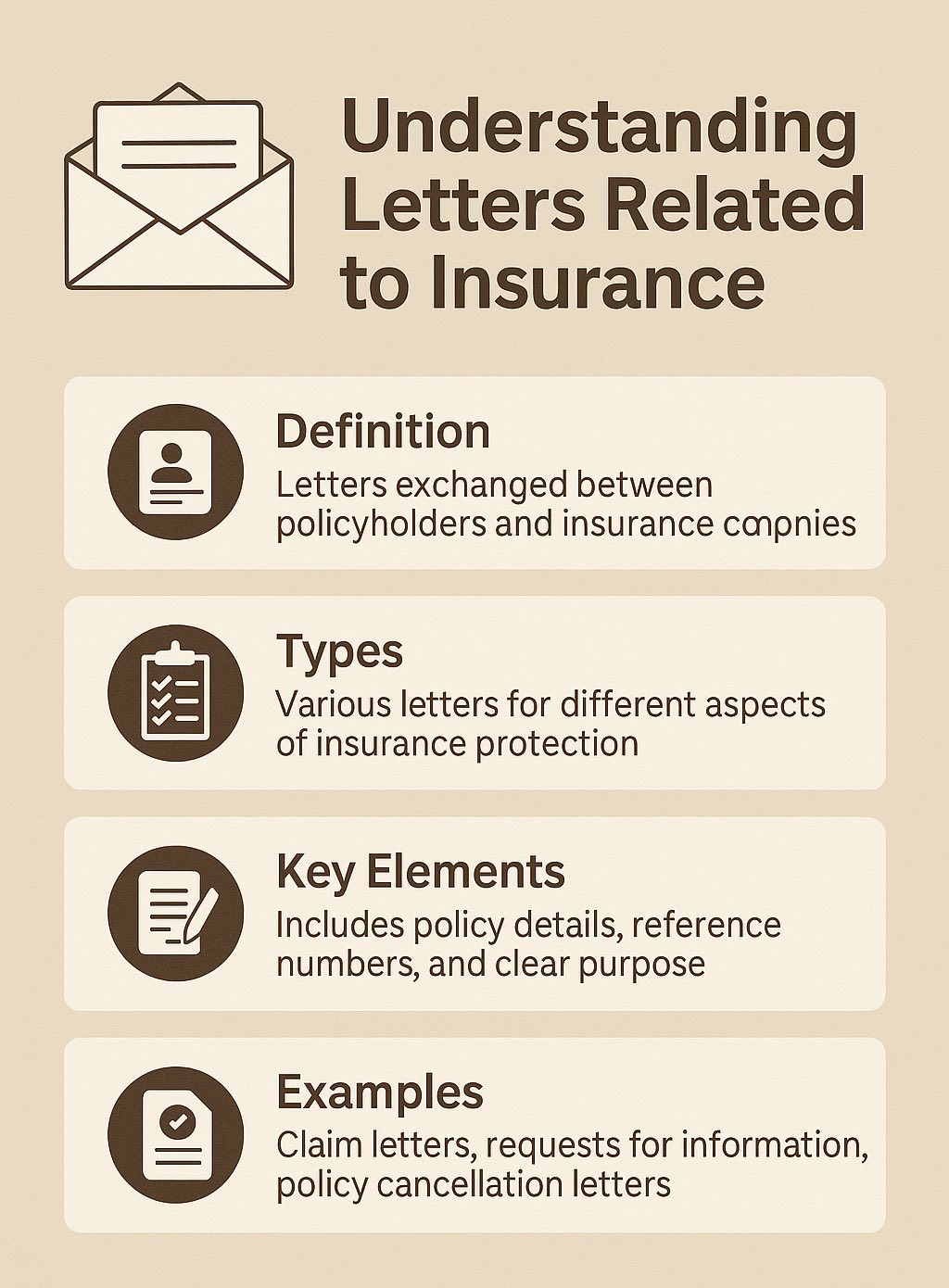
    Understanding Letters Related to Insurance

    Types of Letters Related to Insurance

    Not all insurance letters are the same. Depending on the situation, the format and tone change. Here are the main types:

    1. Letter of Insurance Cover Confirmation

    This letter assures the policyholder that coverage has started. It usually includes policy number, coverage details, and effective date. Imagine buying health insurance and receiving a confirmation letter. That piece of paper is your security blanket.

    2. Claim Intimation Letter

    When a customer faces loss or damage, the first step is to inform the insurer. A claim intimation letter does this job. It mentions what happened, when it happened, and what is being claimed. Without this letter, the claim process cannot begin.

    3. Claim Settlement or Rejection Letter

    Once the insurer investigates, they either settle the claim or reject it. A settlement letter states the amount approved. A rejection letter explains why the claim was denied. Unlike casual emails, these letters must be very clear to avoid disputes.

    4. Premium Payment Reminder Letter

    Insurance companies send polite reminders when a premium is due. These letters often state the due date, amount, and consequences of non-payment. Think of them as gentle nudges to avoid policy lapses.

    5. Policy Renewal or Lapse Notice

    Policies do not last forever. Renewal letters invite policyholders to continue coverage, while lapse notices inform them that the policy has expired. This is similar to getting a subscription reminder but with much higher stakes.

    6. Letter of Endorsement

    Sometimes policyholders want changes, such as adding a new nominee or updating an address. The insurer issues a letter of endorsement to confirm these changes.

    7. Cancellation of Policy Letter

    Not all relationships last, even with insurance companies. Cancellation letters officially terminate the policy. They may be written by the customer or the insurer.

    Interestingly, some of these resemble other formal letters you may know. For example, a cancellation letter has similarities with an order cancellation letter, although the subject is insurance instead of business goods.

    Structure and Format of an Insurance Letter

    Now that we know the types, let us look at the structure. Most insurance letters follow a standard business letter format. If you already know the parts of a business letter, this will sound familiar.

    Key Components:

    • Sender’s address and date
    • Recipient’s name and address
    • Subject line (e.g., Claim Settlement for Policy #12345)
    • Salutation (Dear Mr. Smith)
    • Body of the letter with clear details: policy number, incident date, action required
    • Closing and signature with designation

    What makes insurance letters unique is the heavy use of details. Policy numbers, claim amounts, deadlines, and attached documents are essential. Without them, the letter loses its value.

    Writing Guidelines for Effective Insurance Letters

    Anyone can write a letter, but not everyone can write a clear, professional insurance letter. Here are some guidelines:

    • Be formal yet clear: Do not use casual words like “Hey” or “Thanks a lot.” Keep it professional.
    • Avoid ambiguity: Instead of writing “soon,” mention a specific date.
    • Highlight actions: If the customer must submit documents, mention exactly which ones.
    • Stay polite in rejection letters: Even bad news should be communicated with respect.
    • Follow company rules: Many insurers have templates. Stick to them.

    If you need a refresher on good writing, check out these killer tips for writing a business letter.

    Specimens of Letters Related to Insurance

    Examples make everything clearer, right? Let us look at some sample letters.

    Specimen 1: Policy Issuance Confirmation

    Subject: Confirmation of Policy Coverage
    Dear [Customer Name],
    We are pleased to confirm that your health insurance policy, number 45678, is now active from 01 January 2025. Please find attached the policy document for your records.
    Sincerely,
    [Manager, ABC Insurance]

    Specimen 2: Claim Intimation Letter (Customer to Insurer)

    Subject: Intimation of Claim under Policy #67890
    Dear Sir,
    This is to inform you of a fire incident at my warehouse on 15 March 2025. I request you to process my claim under the fire insurance policy. Supporting documents are attached.
    Sincerely,
    [Customer Name]

    Specimen 3: Claim Settlement Letter

    Subject: Settlement of Claim under Policy #67890
    Dear [Customer],
    We are glad to inform you that your claim has been approved. A payment of $25,000 has been credited to your registered bank account.
    Sincerely,
    [Claims Manager]

    Specimen 4: Premium Payment Reminder

    Subject: Reminder for Premium Due on 10 May 2025
    Dear [Customer],
    This is a gentle reminder that your premium of $500 is due on 10 May 2025. Kindly make the payment to avoid policy lapse.
    Sincerely,
    [Insurance Officer]

    Specimen 5: Cancellation of Policy Letter

    Subject: Policy Cancellation Confirmation
    Dear [Customer],
    As per your request, your motor insurance policy has been canceled effective 01 June 2025. Please contact us if you need further assistance.
    Sincerely,
    [Branch Manager]

    These letters follow the standard structure but differ in tone and content depending on the situation.

    Common Mistakes in Insurance Letters and How to Avoid Them

    Even experienced professionals sometimes make errors in insurance correspondence. Here are common mistakes:

    • Missing key details: Forgetting to mention the policy number or claim amount.
    • Vague language: Writing “We will get back to you soon” instead of giving a date.
    • Ignoring documents: Not attaching necessary forms or reports.
    • Unprofessional tone: Being too casual or too harsh.

    These mistakes can cause disputes or even legal issues. To avoid them, always keep the purpose of business letters in mind. Every word should serve the goal of clarity and professionalism.

    Conclusion

    So, what is meant by a letter related to insurance? It is more than just a formal piece of writing. It is the backbone of communication between insurance companies and customers. From policy confirmation to claim settlement, each letter carries weight.

    By following a proper structure, writing with clarity, and avoiding common mistakes, you can make insurance correspondence effective and professional. Above all, remember that these letters build trust. And trust, in the world of insurance, is everything.

    If you wish to explore related topics, you might also find the types of collection letters interesting. Both insurance letters and collection letters require careful tone and detail to maintain professionalism.

    Share. Facebook Twitter Pinterest LinkedIn WhatsApp Reddit Email
    Previous ArticleDifference Between Official Letter and Business Letter: Key Distinctions Explained
    Next Article Advantages and disadvantages of written communication
    Masudur Rashid
    • Facebook
    • X (Twitter)
    • Instagram
    • LinkedIn

    👋 Hi, I am Masudur Rashid. I studied Management (Honors and Masters) but my real passion has always been Business Communication. Through this blog, I share simple tips, lessons, and resources to help students and professionals communicate with confidence.

    Related Posts

    Report Writing 13 Mins Read

    Advantages And Disadvantages Of Effective Speech In Communication

    Report Writing 13 Mins Read
    Written Communication 18 Mins Read

    Business Report Writing: Steps, Objectives and Formats

    Written Communication 18 Mins Read
    Report Writing 13 Mins Read

    What is Director’s Report? What is Auditor’s Report?

    Report Writing 13 Mins Read
    Report Writing 02 Mins Read

    Ways to Make Grapevine Effective

    Report Writing 02 Mins Read
    Add A Comment
    Leave A Reply Cancel Reply

    This site uses Akismet to reduce spam. Learn how your comment data is processed.

    Subscribe to Updates

    Get the latest business communication news from TBC.

    By signing up, you agree to the our terms and our Privacy Policy agreement.

    Check your inbox or spam folder to confirm your subscription.

    Top Picks

    What is Vertical Communication: Meaning, Types, Examples, and Importance

    Have you ever wondered how information moves inside an organization? Why do managers, supervisors, and…

    Guidelines to Improve effectiveness of Cross Cultural Communication

    Cross-cultural communication has become essential to communicate with multi-cultural people. The following guidelines will help…

    Business Communication – Importance of Business Communication

    For any business to become successful and stand out among its competitors,’ communication has to…

    Grapevine Communication | Factors Liable for Operating Grapevine

    Communication through grapevine is a matter of spontaneous feelings. Some personal matters and other situations…

    Welcome to TheBusinessCommunication.com, your guide to clear and effective business communication. Here you will find simple lessons on report writing, letters, meetings, oral and written communication, and modern tools like email or virtual meetings. Our mission is to make learning communication easy, practical, and fun, so you can apply it in your studies, career, and everyday life.
    We're social. Connect with us:

    Facebook X (Twitter) YouTube LinkedIn RSS
    Top Insights

    What is an Interview? Definition, Purpose And Types

    Methods of Internal Communication

    Order Cancellation Letter: Meaning, Format, Best Practices & Sample Letters

    Subscribe to Updates

    Get the latest business communication news from TBC.

    By signing up, you agree to the our terms and our Privacy Policy agreement.

    Check your inbox or spam folder to confirm your subscription.

    Copyright © 2026 TheBusinessCommunication. All Rights Reserved.
    • Home
    • About Us
    • Contact US
    • Our Authors
    • Privacy Policy
    • Terms and Conditions

    Type above and press Enter to search. Press Esc to cancel.