


What Is Face-to-Face Communication?
Face-to-face communication is a live exchange between two or more people who share the same physical space. They see, hear and answer each other directly. Words, tone, facial expressions, gestures and eye contact all carry the message at once. It is also called personal, in-person or FTF communication.
It is the oldest form of human interaction and a core part of oral communication. Phone calls are oral too, but they lose the visual layer. Meeting in person keeps voice, sight and presence together.
Key Characteristics of In-Person Communication
- Physical presence. Everyone is in the same room, so the setting, distance and posture are part of the message.
- Real-time exchange. You speak and the other person responds at once. There is no typing delay.
- Rich non-verbal channel. Voice, face, hands and posture all send signals alongside the words.
- No tool in between. Nothing sits between the speakers, so nothing can freeze, lag or drop the call.
Why Meeting in Person Still Matters
Business runs on people, and people read each other best when they are together. A handshake, a pause or a smile shapes how a message lands. That is why in-person talk builds trust faster than a thread of messages.
Recent research backs this up. A January 2026 review of 1,158 studies, in Perspectives on Psychological Science, found something clear. People are less engaged, with weaker positive emotions, on video calls or texting than in person. See the Ohio State University summary.
A December 2025 paper in Sensors adds a workplace angle. It notes that virtual meetings tend to show lower group cohesion than in-person ones, and that trust can be harder to build online. See the full paper on PubMed Central.
Three practical effects follow. Meeting in person reduces misunderstandings, because you can fix confusion as soon as you see it. It makes persuasion easier, because commitment is visible. It also speeds up decisions, since people answer questions in the same breath.
Advantages of Face-to-Face Communication
The strengths below explain why high-stakes talks still happen in person. The image sums up all ten points, including the disadvantages covered later.
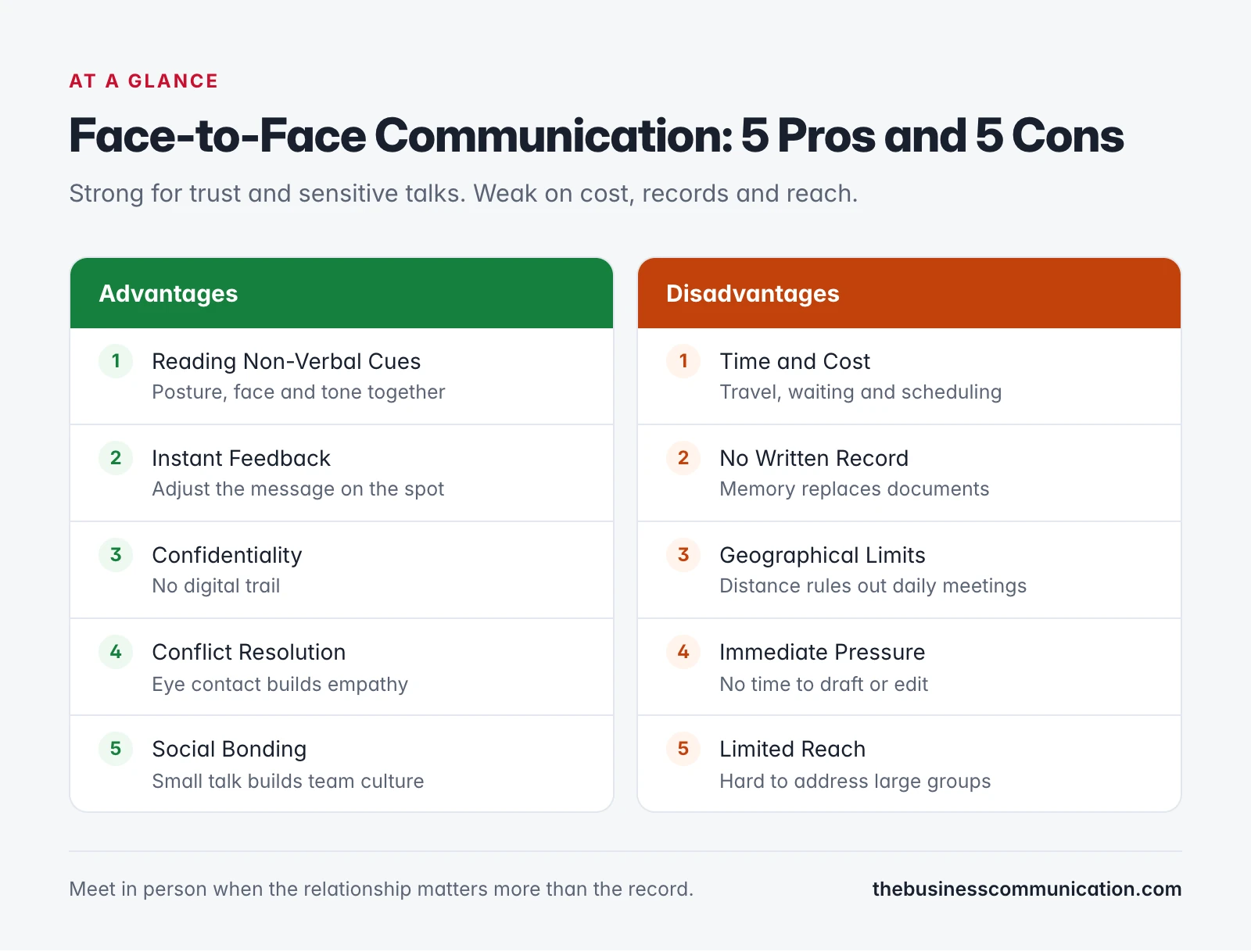
1. Reading Non-Verbal Cues
Words are only part of the story. In person, you can see posture, facial expressions and gestures. Crossed arms may signal defensiveness, while a forward lean suggests interest.
A client may say yes with words and no with their eyes. Face to face, you catch the mismatch. Our guide to non-verbal cues and body language explains the signals to watch.
2. Instant Feedback
You can see confusion the moment it appears. Then you stop, rephrase and check again. In an email, you may not learn about the confusion for days.
This quick loop helps you get past common barriers to effective communication, such as unclear wording or mixed signals.
3. Confidentiality
Anyone can forward an email or screenshot a chat. A private conversation leaves no digital trail. That makes meeting in person a safer choice for trade secrets, salary talks and personnel issues.
4. Conflict Resolution
Arguments in text turn sharp because tone disappears. Eye contact does the opposite. It reminds both sides that a real person is listening. Many disputes that need ten emails can close in one short meeting.
5. Social Bonding
Small talk matters. Asking about a weekend or noticing good news builds familiarity. These moments happen naturally in a room and turn a group of workers into a team.
Disadvantages of Face-to-Face Communication
In-person talk is powerful, but it has limits. Know them before you book the trip.
1. Time and Cost
Travel, parking and waiting all take time. Flying to meet a client adds ticket and hotel costs. You must decide whether the result is worth that investment.
2. No Written Record
A spoken agreement leaves no document. Two people can remember the same talk differently. Fix this by sending a short follow-up email with decisions, owners and dates.
3. Geographical Limits
Your team and clients often sit in different cities or countries. Daily in-person meetings are simply not possible. Digital tools bridge that gap.
4. Immediate Pressure
Some people think best in writing. In a live talk, you must answer now, with no backspace key. That pressure can be stressful, especially for shy speakers or non-native speakers.
5. Limited Reach
One conversation reaches only the people in the room. Announcing a policy to 500 staff in person is slow and uneven. Email, an intranet post or a recorded video does that job better.
Face-to-Face vs Video, Phone and Email
Each channel trades richness for convenience. The table compares the four most common business options.
| Factor | Face-to-face | Video call | Phone call | |
|---|---|---|---|---|
| Non-verbal cues | Full: face, body, tone | Partial: face and tone | Tone only | None |
| Feedback speed | Instant | Near instant | Instant | Delayed |
| Written record | None unless you take notes | Only if recorded | None | Automatic |
| Cost and time | Highest | Low | Low | Lowest |
| Reach | Small group | Medium group | Small group | Very large |
| Best for | Trust, conflict, big deals | Check-ins, remote teams | Quick questions | Records, updates, files |
Video is the closest substitute, but it is not identical. You watch a small screen, see your own face and face notification pings. Long camera hours also tire people, a problem called Zoom fatigue.
Our virtual meeting best practices guide shows how to run better calls.
A fair rule: use video when distance is the only problem. Use an in-person meeting when the relationship is the problem. For more on spoken channels, see oral vs written communication.
Examples of Face-to-Face Communication
These everyday cases are examples of in-person talk in business and study:
- A one-on-one meeting between a manager and an employee
- A team meeting or daily stand-up held in the same room
- A job interview at the employer’s office
- A sales visit where a representative meets a client
- A town hall where leaders speak to staff and take questions
- A student asking a lecturer a question during office hours instead of emailing
- A negotiation across the table between a buyer and a supplier
How to Improve Your Face-to-Face Skills
Good in-person talk is a learnable skill. Try these six habits:
- Prepare your main point. Write the one sentence you want the other person to remember.
- Make eye contact. Hold it for a few seconds at a time, then look away naturally.
- Listen fully. Do not plan your reply while the other person speaks. Our guide to active listening shows how.
- Match words and body. Open posture and a steady voice support what you say.
- Ask clarifying questions. Try “Did I understand you correctly?” before you answer.
- Summarise at the end. Restate decisions and next steps, then confirm them by email.
Tips for a Difficult Conversation
Hard talks need extra care. Plan your key message first. Choose a private place and a calm time. Start with facts, not blame. Pause often, listen without interrupting, and do not take emotions personally. Agree on one next step before you leave.
When Should You Choose Face-to-Face Communication?
You cannot meet everyone, so save in-person time for moments that need it.
- Hiring or firing. A life-changing message deserves respect and a human voice.
- High-stakes deals. Showing up signals commitment and lets you read the room.
- Complex brainstorming. Groups sharing a whiteboard build ideas faster than a screen share.
- Apologies and conflict. A spoken apology sounds sincere in a way a message rarely does.
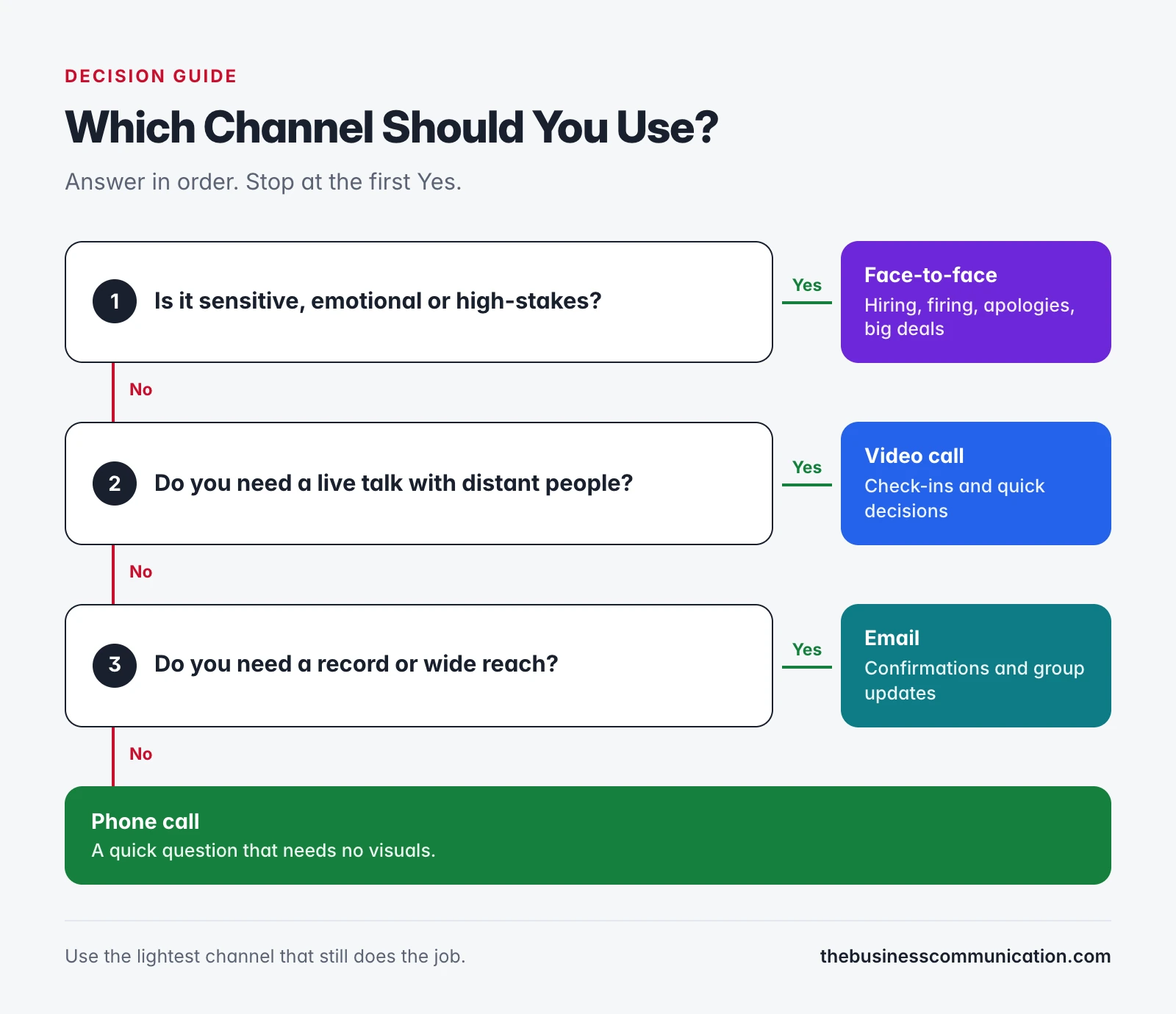
If none of these apply, the decision guide below helps you pick the lightest channel that still works.
Exam Quick Answer
Students often need a short answer. Use this version:
- Definition: A direct, real-time exchange between people in the same place.
- Characteristics: Physical presence, instant feedback and rich non-verbal cues.
- Advantages: Trust, quick clarification and confidentiality.
- Disadvantages: Cost, no written record and limited reach.
For a wider view, read the advantages and disadvantages of oral communication and the communication process.
Conclusion
Use email when you need a record and video when distance is the obstacle. Meet in person when trust, emotion or a big decision is on the table, then confirm the outcome in a short email.
Frequently Asked Questions
What is an example of face-to-face communication?
A manager meeting an employee for a one-on-one review is a typical example. Others include job interviews, sales visits, team meetings and a student speaking to a lecturer in office hours. All involve people in the same place, talking in real time.
Why is face-to-face communication the most effective?
It combines words, tone, facial expressions and body language in one live exchange. You can spot confusion at once and fix it. That builds trust and reduces misunderstandings. It is not always the best channel, though, as it costs time and leaves no record.
What is face-to-face communication called?
It is commonly called personal communication, in-person communication or FTF interaction. Some textbooks also call it interpersonal oral communication, because it is spoken and happens between people directly.
Is face-to-face communication better than texting?
For emotional, sensitive or complex topics, yes. In person you hear tone and see reactions, so messages are less likely to be misread. Texting is better for quick facts, links and anything you need in writing.
Is it better to communicate face-to-face or online?
It depends on the goal. Meet in person to build trust, resolve conflict or close important deals. Go online when distance, cost or speed matters, or when you need a written record. Many teams mix both.
What are the disadvantages of face-to-face communication?
The main disadvantages are travel time and cost, no automatic written record, distance limits, pressure to answer immediately and limited reach for large audiences. A follow-up email fixes the record problem.
8 Comments
You made to understand what face to face conversation is? thank
Nice
but
If we are trying in notes for also too good then
these notes are too satisfy to student
Thank you for sharing such an article on various aspects of communication.
Very true thanks
You don’t know how much this helped me
Sometimes we conduct the face to face interview, couldn’t it be called formal conversation?
yes u gorm
Very helpfull indeed. I am presenting on a very short notice and this site came in very handy for me.