

Close Menu
The Business CommunicationThe Business Communication
    What's Hot

    Memo vs. Business Letter: Key Differences & When to Use Which

    December 3, 2025

    Mastering Negotiation Skills: The Role of Oral Communication

    December 2, 2025

    Non-Verbal Cues: How Body Language Impacts Oral Communication

    December 2, 2025
    Facebook X (Twitter)
    The Business CommunicationThe Business Communication
    Button
    • Basics
      1. Introduction
      2. Communication Skills
      3. Modern Communication
      4. View All

      Types of Communication | Different Types of Communication

      October 7, 2025

      Qualities of good communication | Requirements of effective communication

      September 26, 2025

      Business Communication Roles: Key Functions And Examples

      September 9, 2025

      What is Communication Process? Steps And Examples Explained

      September 7, 2025

      Meaning Of Cross-Cultural Communication

      October 19, 2025

      8 Ways To Improve Your Listening Skills

      August 11, 2025

      Various Styles Reading or Techniques of Reading

      July 6, 2025

      What Is Communication Style | Classification Of Communication Style

      March 16, 2025

      What Is The Video Conference? Advantages & Disadvantages of Video Conferencing

      April 30, 2025

      Advantages And Disadvantages Of Satellite Television In Business Communication

      November 16, 2024

      What Is Voicemail? Advantages and Disadvantages Of Voicemail

      October 13, 2024

      What Is Communication Satellite?

      August 12, 2024

      Memo vs. Business Letter: Key Differences & When to Use Which

      December 3, 2025

      Mastering Negotiation Skills: The Role of Oral Communication

      December 2, 2025

      Non-Verbal Cues: How Body Language Impacts Oral Communication

      December 2, 2025

      Glossophobia: How to Overcome the Fear of Public Speaking

      December 2, 2025
    • Forms of Communication
      • Oral Communication
      • Non-Verbal Communication
      • Report Writing
    • Written Communication
      1. Letter Writing
      2. Circular Letter
      3. inquiry letter
      4. Ultimatum Letter
      Featured
      Letter Writing

      Memo vs. Business Letter: Key Differences & When to Use Which

      By Masudur RashidDecember 3, 2025
      Recent

      Memo vs. Business Letter: Key Differences & When to Use Which

      December 3, 2025

      Advantages and Disadvantages of Business Letter: A Comprehensive Analysis

      October 20, 2025

      Inquiry Letter for Job Vacancy (Samples & Email Scripts)

      October 19, 2025
    • In Business
      1. Company Meeting
      2. Secretarial Functions
      3. View All

      Virtual Meetings for Companies: Tools, Etiquette & Challenges

      October 19, 2025

      Participants Responsibilities in Meeting

      October 7, 2025

      Meaning of Company Secretary | Appointment of Company Secretary

      May 29, 2025

      What is Annual Business Report – The Business Communication

      January 22, 2025

      What is Secretary? Types of secretary

      January 21, 2025

      What Is Organizational Communication – Types of Organizational Communication

      December 18, 2024

      Functions of a Private Secretary

      April 21, 2024

      Qualifications of a Private Secretary

      October 4, 2023

      Memo vs. Business Letter: Key Differences & When to Use Which

      December 3, 2025

      Mastering Negotiation Skills: The Role of Oral Communication

      December 2, 2025

      Non-Verbal Cues: How Body Language Impacts Oral Communication

      December 2, 2025

      Glossophobia: How to Overcome the Fear of Public Speaking

      December 2, 2025
    • Internal Communication
      1. Downward Communication
      2. Horizontal Communication
      3. Upward Communication
      4. View All

      Essential Elements of Downward Communication: A Complete Guide for Managers

      August 17, 2025

      Key Objectives of Downward Communication in an Organization

      June 26, 2025

      The Effectiveness of Downward Communication: Factors, Barriers, and Measurement

      April 13, 2025

      Advantage And Disadvantages of downward communication

      April 10, 2025

      Upward vs Downward vs Horizontal Communication: Key Differences

      December 19, 2024

      Differences Between Horizontal and Vertical Communication

      September 21, 2024

      What is Horizontal Communication: Definition, Examples & Importance

      March 15, 2024

      Importance of Horizontal Communication (With Real-Life Examples)

      December 28, 2023

      Psychological Safety & Upward Communication: Building Trust at Work

      October 25, 2025

      Common Barriers to Effective Upward Communication and Solutions

      October 15, 2025

      Future of Upward Communication in Remote/Hybrid Workplaces

      May 29, 2025

      Upward vs Downward vs Horizontal Communication: Key Differences

      December 19, 2024

      Memo vs. Business Letter: Key Differences & When to Use Which

      December 3, 2025

      Mastering Negotiation Skills: The Role of Oral Communication

      December 2, 2025

      Non-Verbal Cues: How Body Language Impacts Oral Communication

      December 2, 2025

      Glossophobia: How to Overcome the Fear of Public Speaking

      December 2, 2025
    The Business CommunicationThe Business Communication
    Home » Introduction » What is Vertical Communication: Meaning, Types, Examples, and Importance

    What is Vertical Communication: Meaning, Types, Examples, and Importance

    By Masudur Rashid17 Comments6 Mins Read Introduction
    Facebook Twitter Reddit WhatsApp Telegram Pinterest LinkedIn Email
    Share
    Facebook Twitter Pinterest WhatsApp Email

    Have you ever wondered how information moves inside an organization? Why do managers, supervisors, and employees constantly exchange messages, reports, and feedback? Well, this movement of information is known as communication flow. Among the different types, vertical communication plays a vital role in keeping everything organized and efficient.

    Vertical communication connects people at different levels of authority. It ensures that ideas, decisions, and feedback smoothly travel between top management and lower staff. Without it, every office would turn into a noisy market of mixed messages!

    Let’s explore what vertical communication really means, how it works, and why it’s so important for every successful business.

    Definition of Vertical Communication

    Vertical communication refers to the flow of information between different levels in an organization’s hierarchy. It moves up and down through the chain of command. When information goes from higher management to lower employees, it is called downward communication. On the other hand, when information travels from subordinates to their superiors, it is known as upward communication.

    This communication helps maintain order, discipline, and clear direction inside the workplace. It also allows employees to share feedback and ideas that might improve business operations.

    If you’d like to know more about how messages move from employees to managers, check out this detailed post on Upward Communication Case Studies.

    Direction of Vertical Communication

    1. Upward Communication

    Upward communication moves from lower-level employees to higher-level managers. It helps top management understand how things are going at the operational level. Employees use reports, feedback forms, and meetings to share their progress or raise concerns.

    For instance, if workers report production issues to their supervisors, that’s a perfect example of upward communication. It improves transparency and teamwork.

    To explore its advantages and challenges, visit Advantages and Disadvantages of Upward Communication.

    2. Downward Communication

    Downward communication flows from top executives to the employees. It usually includes instructions, company policies, performance goals, and strategic plans. Managers often use emails, circulars, or staff meetings to pass down information.

    When used properly, downward communication makes sure everyone understands their roles. However, if the message becomes too long or unclear, it may cause confusion. To understand this better, read about Advantages and Disadvantages of Downward Communication.

    Types of Vertical Communication

    There are mainly two types of vertical communication:

    Formal Vertical Communication

    This follows official paths such as reports, memos, meetings, and emails. Every piece of information passes through a defined channel. For example, an employee may first report to a supervisor, then to a manager, and finally to a director.

    You can learn how formal communication compares to informal communication in Formal vs Informal Communication: Differences and Examples.

    Informal Vertical Communication

    Sometimes, people skip the formal ladder and communicate directly in an informal way. It might be through quick chats, phone calls, or even text messages. Though less official, it helps solve issues faster when time is short.

    Key Features of Vertical Communication

    Vertical communication comes with several key characteristics:

    • It follows the chain of command.
    • Information flows either upward or downward.
    • It encourages feedback between employees and management.
    • Messages are often structured and purposeful.
    • It builds accountability and trust within teams.

    Each of these features ensures that communication remains clear, accurate, and aligned with company goals.

    vertical communication

    Importance of Vertical Communication

    Communication is the lifeblood of an organization. But why is vertical communication so crucial? Let’s find out.

    1. Ensures Coordination: It connects every department and level so that everyone works toward the same goal.
    2. Improves Decision-Making: Managers get feedback from employees before making policies.
    3. Motivates Employees: Workers feel valued when their opinions are heard.
    4. Maintains Discipline: Clear instructions from top levels reduce confusion.
    5. Encourages Accountability: Everyone knows who is responsible for what.

    To understand how internal communication benefits overall growth, read Advantages of Internal Communication.

    Examples of Vertical Communication

    Here are some everyday examples you’ll notice in workplaces:

    • A CEO sending a memo about company policy changes.
    • An employee submitting a monthly performance report.
    • A manager giving instructions to a team leader.
    • A worker sharing feedback about new equipment.

    In each case, messages move vertically through ranks. This system keeps the organization running like a well-oiled machine.

    You can also explore how communication works across departments by checking Differences Between Horizontal and Vertical Communication.

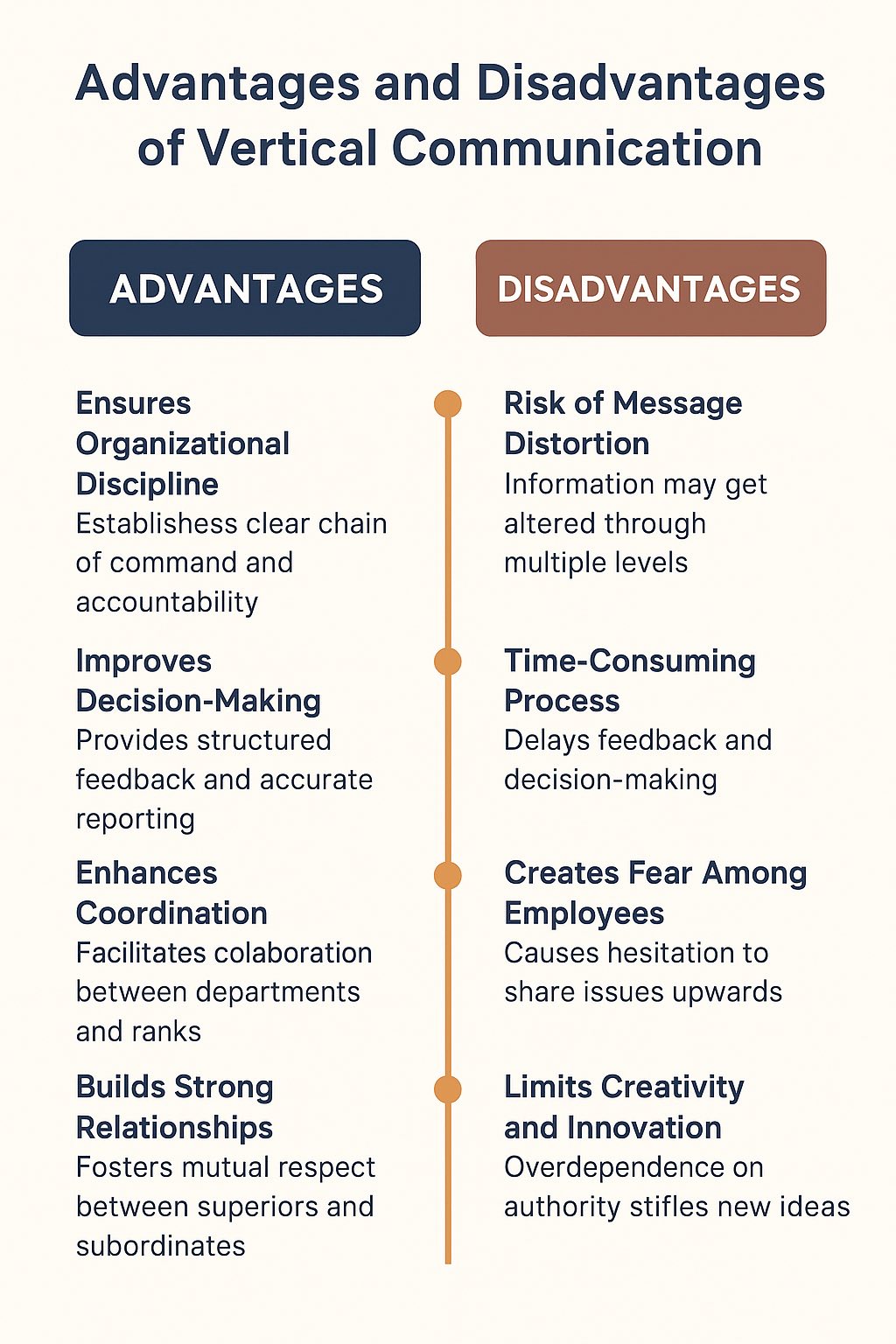
    Advantages of Vertical Communication

    Let’s highlight some key benefits:

    1. Clear Authority Lines: Everyone knows who gives instructions and who receives them.
    2. Smooth Policy Implementation: Information flows systematically from the top to the bottom.
    3. Encourages Feedback: Workers can share suggestions for improvement.
    4. Boosts Team Discipline: It keeps everyone aligned with company rules.
    5. Builds Trust: Regular communication strengthens professional relationships.

    Moreover, vertical communication helps in performance evaluation and continuous improvement.

    To understand how communication improves overall management, visit Role of Communication in Management.

    Disadvantages or Limitations

    Despite its benefits, vertical communication has some drawbacks:

    • Slow Flow of Information: Messages often pass through multiple layers, which can delay decisions.
    • Distortion of Messages: Information may get changed as it moves up or down.
    • Fear Among Employees: Workers might hesitate to share honest feedback.
    • Lack of Innovation: Strict hierarchy can limit creativity.

    Still, organizations can overcome these problems with open feedback systems and supportive leadership.

    You might also like to read Overcome the Communication Barriers in Business for practical strategies.

    How to Make Vertical Communication Effective

    To make vertical communication more effective, follow these tips:

    1. Encourage Two-Way Feedback: Allow employees to freely share their opinions.
    2. Simplify Channels: Reduce unnecessary layers in the hierarchy.
    3. Use Technology Wisely: Tools like intranet and video meetings can speed up communication.
    4. Train Leaders: Managers should know how to listen actively.
    5. Build a Trust Culture: Encourage honesty and respect in all communications.

    Vertical Communication vs Horizontal Communication

    Although both types are essential, they serve different purposes.

    FeatureVertical CommunicationHorizontal Communication
    DirectionUpward and DownwardBetween same-level employees
    PurposeControl and CoordinationCooperation and Collaboration
    ExampleManager to EmployeeMarketing Manager to Sales Manager
    StructureHierarchicalFlexible

    Want to explore this comparison in more detail? Read Advantages and Disadvantages of Horizontal Communication.

    Real-World Case Study

    Imagine a large company like Toyota. The production team reports issues to supervisors, who then inform higher management. After analyzing the situation, the management sends back instructions. This constant vertical exchange keeps the company’s quality high and customers satisfied.

    If upward communication failed, these issues would never reach decision-makers, leading to delays and loss. That’s why vertical communication is the backbone of successful organizations.

    Final Thoughts

    Vertical communication is more than just sending memos or attending meetings. It’s about creating a clear flow of ideas, feedback, and actions across all levels of an organization. Both upward and downward communication must work together to keep everyone informed, motivated, and accountable.

    When used properly, it improves performance, encourages transparency, and strengthens organizational unity. So, if you ever plan to lead a team or manage a company, remember that effective vertical communication is your best friend!

    Advantages Disadvantages Vertical Communication What is
    Share. Facebook Twitter Pinterest LinkedIn WhatsApp Reddit Email
    Previous ArticleBusiness Letter Formats: Block, Modified Block & Semi-Block
    Next Article Internship Inquiry Email to HR/Manager (Copy-Paste Templates)
    Masudur Rashid
    • Facebook
    • X (Twitter)
    • Instagram
    • LinkedIn

    👋 Hi, I am Masudur Rashid. I studied Management (Honors and Masters) but my real passion has always been Business Communication. Through this blog, I share simple tips, lessons, and resources to help students and professionals communicate with confidence.

    Related Posts

    Introduction 13 Mins Read

    Types of Communication | Different Types of Communication

    Introduction 13 Mins Read
    Introduction 03 Mins Read

    Qualities of good communication | Requirements of effective communication

    Introduction 03 Mins Read
    Introduction 207 Mins Read

    Business Communication Roles: Key Functions And Examples

    Introduction 207 Mins Read
    Introduction 598 Mins Read

    What is Communication Process? Steps And Examples Explained

    Introduction 598 Mins Read
    View 17 Comments

    17 Comments

    1. Mwetta jr on February 27, 2023 9:38 am

      Ooooh thanks alot

      Reply
    2. reile jovia on March 22, 2023 11:09 am

      good ..
      so educative

      Reply
    3. patrick on August 20, 2023 8:58 pm

      very helpful …thank youuu

      Reply
    4. aleck on September 12, 2023 10:06 pm

      nice explanation of vertical communication, thank you

      Reply
    5. Ian oduor on March 30, 2024 11:04 pm

      Satisfied thanks

      Reply
    6. Hassan Kenny on June 3, 2024 9:33 pm

      Well done

      Reply
    7. 11 WINNER APK on June 22, 2024 6:56 am

      Great insights on vertical communication! I appreciate how you highlighted both the advantages and disadvantages. It’s crucial for organizations to find the right balance to ensure effective information flow. This post has given me a lot to think about in terms of improving communication within my team. Thank you!

      Reply
    8. Pascal Laurent Mwaweza on October 19, 2024 6:23 am

      It is well understood

      Reply
    9. md.lachu on October 26, 2024 7:03 am

      very good

      Reply
    10. Ekemini Nyong on December 3, 2024 8:57 am

      Thanks

      Reply
    11. Phiwe Izalobuhle Ndlovu on March 10, 2025 10:53 pm

      Wow what a great source, l was greatly assisted thanks a lot😊

      Reply
    12. Duncan on March 13, 2025 4:07 pm

      Thanks alot it’s well understandable

      Reply
    13. jaelana on April 8, 2025 7:04 am

      hi ,i think it was a pretty understandable article

      great job

      Reply
    14. Iddi h awesi on May 19, 2025 3:10 pm

      Good explanation

      Reply
    15. swiznaye murwira on August 21, 2025 11:23 am

      Understandable
      Well done!!!

      Reply
      • Kimberly KT on June 26, 2024 6:03 pm

        Thank you 💕

        Reply
    16. becky on September 7, 2025 12:36 pm

      simple language,understandable.thanks

      Reply
    Leave A Reply Cancel Reply

    This site uses Akismet to reduce spam. Learn how your comment data is processed.

    Subscribe to Updates

    Get the latest business communication news from TBC.

    By signing up, you agree to the our terms and our Privacy Policy agreement.

    Check your inbox or spam folder to confirm your subscription.

    Top Picks

    Types of Communication | Different Types of Communication

    Here you will get about kinds or classification or Types of communication. There are several…

    Qualities of good communication | Requirements of effective communication

    Whenever the sender and also recipient understand the meaning connected with communication virtually just as,…

    Business Communication Roles: Key Functions And Examples

    In every workplace, communication is the glue that holds everything together. It connects teams, builds…

    What is Communication Process? Steps And Examples Explained

    Have you ever played the “telephone game” as a child? Someone whispers a message, and…

    Welcome to TheBusinessCommunication.com, your guide to clear and effective business communication. Here you will find simple lessons on report writing, letters, meetings, oral and written communication, and modern tools like email or virtual meetings. Our mission is to make learning communication easy, practical, and fun, so you can apply it in your studies, career, and everyday life.
    We're social. Connect with us:

    Facebook X (Twitter) YouTube LinkedIn RSS
    Top Insights

    Memo vs. Business Letter: Key Differences & When to Use Which

    Mastering Negotiation Skills: The Role of Oral Communication

    Non-Verbal Cues: How Body Language Impacts Oral Communication

    Subscribe to Updates

    Get the latest business communication news from TBC.

    By signing up, you agree to the our terms and our Privacy Policy agreement.

    Check your inbox or spam folder to confirm your subscription.

    Copyright © 2025 TheBusinessCommunication. All Rights Reserved.
    • Home
    • About Us
    • Contact US
    • Our Authors
    • Privacy Policy
    • Terms and Conditions

    Type above and press Enter to search. Press Esc to cancel.