


Imagine you are the CEO of a huge company. One morning, you wake up to terrible news. Your main product has a major defect. Customers are angry, and your stock price is falling fast.
What do you do in this situation?
You cannot call every single customer personally to apologize. You cannot visit every shareholder’s home to explain the situation. You need a way to reach everyone at once, and you need to do it fast.
This is where the magic happens. It is the intersection of two powerful business functions: Public Relations (PR) and Mass Communication.
PR provides the strategy. It tells you what to say to rebuild trust. Mass Communication provides the megaphone. It gives you the tools to say it to the world.
For any student of business, understanding the relationship between PR and mass media is essential. In the modern world, a company cannot manage its reputation without it.
Before we dive deep, make sure you have a solid grasp of the basics. You can review our guide on what is mass communication to refresh your memory on the foundational concepts.
Now, let’s explore how PR professionals use these powerful tools to shape public perception.
The Symbiotic Relationship: Media Relations vs. Public Relations
Many students get confused here. They often use the terms “PR” and “Media Relations” interchangeably. While they are related, they are not the same thing.
Think of Public Relations as a big umbrella. It covers all the ways an organization builds relationships with its various publics. These publics include employees, investors, government officials, and customers.
Media Relations is a specific part under that umbrella. It focuses solely on building relationships with journalists, editors, and influencers working in mass media.
The Exchange
It is a symbiotic relationship. Both sides need each other.
Mass media outlets need a constant stream of news to fill their pages and airtime. They need stories that will engage their audience. PR professionals provide this “information subsidy” in the form of press releases, data, and access to executives.
In return, the mass media provides something PR pros cannot buy, which is credibility.
When a respected newspaper writes a positive story about your company, the public believes it more than a paid ad. This is called “Earned Media.” PR professionals use mass communication channels primarily to gain this valuable Earned Media.
How PR Utilizes Mass Communication Channels (Traditional & Digital)
A PR strategy is only as good as its delivery system. You might have the best message in the world, but if nobody hears it, it does not matter.
PR professionals use every tool in the mass communication toolkit to reach their audience. This includes both traditional and digital platforms.
Utilizing Traditional Gatekeepers (Print & Broadcast)
For decades, the only way to reach a mass audience was through traditional media.
PR pros would write a press release and fax it to newsrooms. They would pitch stories to editors at newspapers and magazines. They would try to get their CEO booked for an interview on the evening news.
This reliance on print media mass communication is still vital today.
Why? Because these outlets still command huge, diverse audiences. A front-page story in a national newspaper still carries immense weight.
Similarly, appearing on television or radio through broadcast media mass communication channels gives a brand instant legitimacy. It reaches millions of people in their living rooms.
However, to get that coverage, PR pros have to pass the “gatekeepers.” Remember the gatekeeper concept from our post on the mass communication process? These are the editors who decide what gets published. A big part of PR is convincing these gatekeepers that your company’s story is newsworthy.
The Digital Shift: Direct-to-Consumer PR
The internet changed everything. It disrupted the traditional model.
Suddenly, organizations did not need to rely solely on journalists to carry their message. They could become their own media outlet.
PR professionals now use digital media mass communication channels to speak directly to the public. They publish news on corporate blogs. They share updates on social media platforms like Twitter and LinkedIn. They send newsletters directly to subscribers.
This “Direct-to-Consumer” model allows for more control over the message. There is no middleman to misinterpret your quote or cut your paragraphs.
Furthermore, it gave rise to influencer marketing. Today, a PR strategy might involve sending products to a YouTube star just as often as pitching a story to a newspaper reporter.
Key Functions of Mass Communication in PR Strategies
So, we know PR uses mass media tools. But to do what, exactly?
Mass communication is not just about blasting out information. It is used strategically to achieve specific business goals.
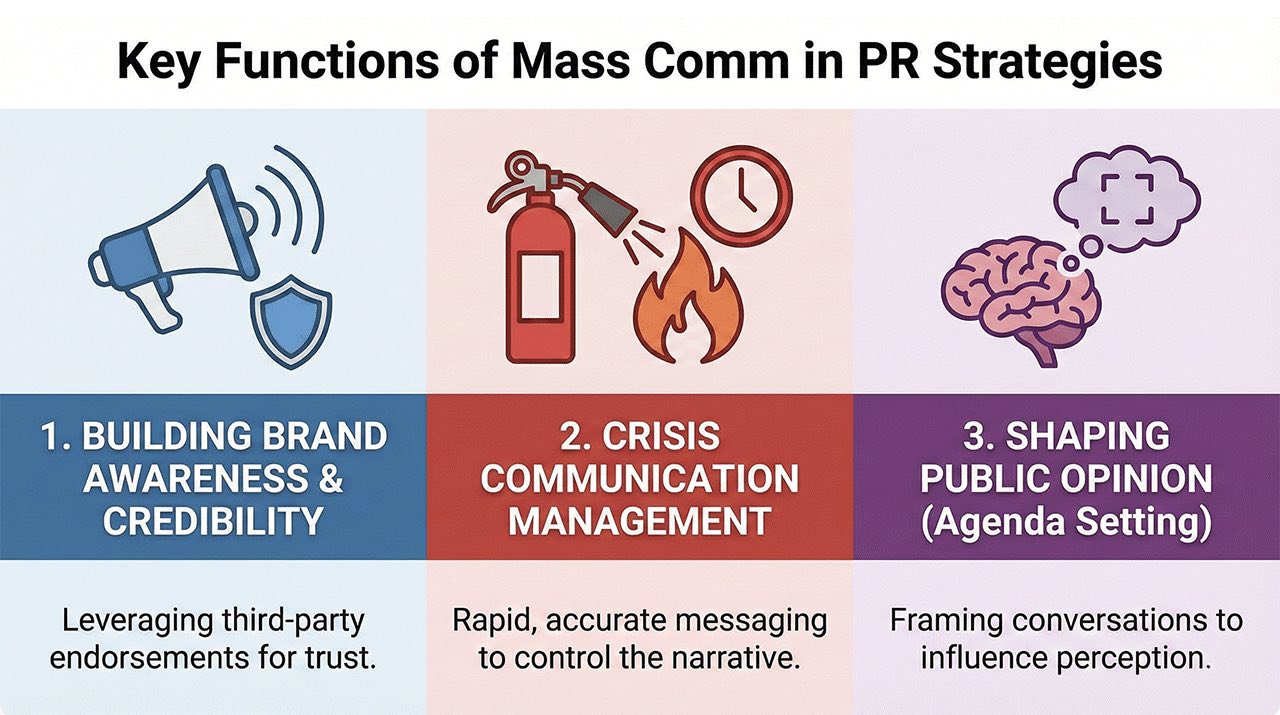
Here are the three primary functions of mass communication within a PR strategy.
1. Building Brand Awareness and Credibility
If you launch a new startup, nobody knows who you are. You need awareness.
You could buy ads. But ads are expensive, and people are skeptical of them.
Instead, a PR team will use mass media to build credibility. They might pitch a story to a tech blog about your innovative new product. When that blog writes a positive review, it acts as a “third-party endorsement.”
The audience thinks, “If this respected tech site likes them, they must be good.” This builds trust much faster than any paid advertisement could. Mass communication allows you to borrow the credibility of established media outlets.
2. Crisis Communication Management
This is where the speed and reach of mass media become critical.
When a crisis hits, like a data breach or a product recall, minutes matter. Rumors spread like wildfire on social media.
The only way to combat this is with rapid, accurate mass communication.
PR teams use social media to issue instant statements to the public. They hold press conferences that are broadcast live on TV news. They use their website as a central hub for factual information.
In a crisis, mass communication is the firehose you use to put out the flames of misinformation. Without it, the narrative goes out of your control completely.
3. Shaping Public Opinion (The Theoretical Link)
This is the most powerful, and sometimes controversial, function.
PR professionals use mass media to influence what people think about their organization or industry. This is not about brainwashing. It is about framing the conversation.
Think back to the theories we discussed. Do you remember the Agenda Setting Theory from our guide on mass communication theories? It states that the media doesn’t tell people what to think, but what to think about.
Guess who is often behind the scenes, pitching those topics to the media? PR professionals.
If a renewable energy company wants the public to care more about climate change, their PR team will pitch stories about environmental issues to journalists. By getting the media to talk about it, they put it on the public’s agenda. This creates a favorable environment for their business.
Challenges for PR in the Modern Mass Media Landscape
It is not all smooth sailing. The modern media landscape presents new challenges for PR professionals.
It is noisier and more fragmented than ever before.
Media Fragmentation
In the old days, you could place a story on the three big TV networks and reach almost everyone in the country.
Today, the audience is scattered. They are on hundreds of cable channels, thousands of websites, and countless social media niches.
Reaching a “mass” audience now requires a multi-channel strategy. You have to tailor your message for TikTok, for a business podcast, and for The Wall Street Journal all at the same time. This is more work and requires more specialized skills.
Information Overload (Clutter)
We are living in an age of information overload. People are bombarded with messages every second of the day.
For a PR professional, the biggest challenge is cutting through this “clutter.” Your press release might be perfect, but if it is buried under 500 other emails in a journalist’s inbox, it will never see the light of day.
Crafting a story that is truly compelling and relevant is harder than ever.
Fake News and Misinformation
Finally, the speed of digital mass media is a double-edged sword. It allows PR pros to communicate fast, but it also allows false information to spread just as quickly.
A malicious rumor about a company can go viral on social media before the PR team even knows it exists.
Modern PR is often a battle against misinformation. Professionals have to constantly monitor mass media channels and be ready to correct false narratives instantly.
Conclusion
Public Relations and Mass Communication are two sides of the same coin. You cannot have an effective PR strategy in the modern world without leveraging the power of mass media.
PR provides the message, the strategy, and the goals. Mass communication provides the channels, from newspapers to tweets, to deliver that message to a large, diverse audience.
Whether it is building a brand from scratch, managing a sudden crisis, or subtly shaping public opinion over time, mass media is the essential toolkit for the PR professional.
While the tools change from print to digital, the core need remains the same. Businesses need to communicate with the masses to build and protect their reputation.
If you are interested in how these strategies play out in the real world, you should explore the broader scope of mass communication. It will give you a bigger picture of the industry and help you see where PR fits into the grand scheme of things.
1 Comment
This article is very much helpful for me.