


Imagine a large waterfall. The water starts at the very top, gathers momentum, and flows all the way down to the pool below. In the corporate world, information moves in a very similar way. This is what we call downward communication. It is the lifeblood of any hierarchical organization.
However, simply shouting orders from the executive suite is not enough. You need structure. You need clarity. Above all, you need to understand the essential components that make this flow work. If the water gets blocked halfway down, the pool at the bottom dries up. Similarly, if your message gets stuck in middle management, your frontline employees are left in the dark.
In this guide, we will break down the five essential elements of downward communication. We will explore how to use them effectively to build a team that is not just obedient, but truly engaged and informed.
What is Downward Communication?
Before we dive into the specific elements, let’s quickly set the stage. Downward communication occurs when information flows from a higher level of an organization to a lower level. Think of it as the CEO speaking to managers, or managers speaking to their teams.
The primary goal here is to direct, influence, and give feedback. It sounds simple, right? Yet, it is one of the most difficult things to get right. Messages often get distorted as they pass through different levels of authority. This is often referred to as the “telephone game” effect in business.
To get a solid grasp of the foundational concepts, you might want to read our detailed definition of what is downward communication. It covers the basic framework that every manager should know.
The 5 Essential Elements of Downward Communication
According to Daniel Katz and Robert L. Kahn, two pioneers in organizational psychology, there are five specific types of communication that flow downward. Understanding these distinctions is the key to mastering leadership communication.
If you rely on just one or two of these, your management style might be incomplete. Let’s look at them in detail.
1. Job Instructions
This is the most basic form of management communication. Job instructions are the directives that tell employees what they need to do. It covers the specific tasks, duties, and responsibilities associated with a role.
For example, a sales manager might tell a representative to “Make 50 cold calls by Friday.” This is a direct job instruction. It leaves little room for ambiguity.
However, a common mistake managers make is assuming the employee knows how to do the task. Effective job instructions must be precise. They should include the necessary tools, deadlines, and quality standards. If instructions are vague, the output will be messy.
2. Job Rationale
This is where many leaders fail. Job instructions tell people what to do. Job rationale explains why they are doing it.
Imagine you are asked to move a pile of heavy stones from one side of a yard to another. You do it. Then, you are asked to move them back. You would feel frustrated, right? But what if you were told that moving the stones helps test the soil stability for a new hospital? Suddenly, the boring task has a purpose.
Providing job rationale connects the individual task to the larger organizational goals. It helps employees understand their contribution to the big picture. When people know the “why,” they are more motivated and engaged.
3. Procedures and Practices
Every organization runs on a set of rules. These are the policies, regulations, benefits, and standard operating procedures (SOPs). This element of downward communication ensures that everyone plays by the same rules.
It includes information about:
- Sick leave and vacation policies.
- Safety regulations.
- Overtime rules.
- Company benefits.
Clear communication of procedures creates a sense of fairness. If one employee thinks the rules are different for them, resentment builds up. Usually, this type of information is shared through employee handbooks or official circulars.
4. Feedback
Feedback is the breakfast of champions. In the context of downward communication, feedback refers to the evaluation of an employee’s performance. It flows from the supervisor to the subordinate.
Feedback serves two main purposes. First, it corrects behavior that is off track. Second, it reinforces behavior that helps the company succeed.
Sadly, many managers only communicate feedback when something goes wrong. This is a trap. You should also provide positive reinforcement. Regular performance reviews are a standard method for this. However, immediate verbal feedback is often more effective than a formal review that happens once a year.
5. Indoctrination
The word “indoctrination” might sound a bit intense. In a business context, it simply refers to instilling the company’s mission, vision, and culture into the workforce. This is about rallying the troops.
Indoctrination seeks to get employees emotionally invested in the organization. It answers the question, “Who are we, and what do we stand for?”
When a CEO gives an inspiring speech about the company’s future during a town hall meeting, that is indoctrination. It creates a shared identity. Without this element, employees are just mercenaries working for a paycheck. With it, they become team members working for a cause.
The Core Objectives Behind the Flow
Why do we go through all this trouble? Why not just let everyone do their own thing? Well, an organization without direction is just a crowd of people.
The main objective is to coordinate efforts. You want the marketing team, the sales team, and the product team to move in the same direction. Downward communication aligns these diverse groups.
It also serves to maintain discipline. By clearly stating authority and responsibilities, you avoid power struggles. If you are interested in a deeper dive into the goals of management, you should check our post on the objectives of downward communication.
Common Mediums Used by Managers
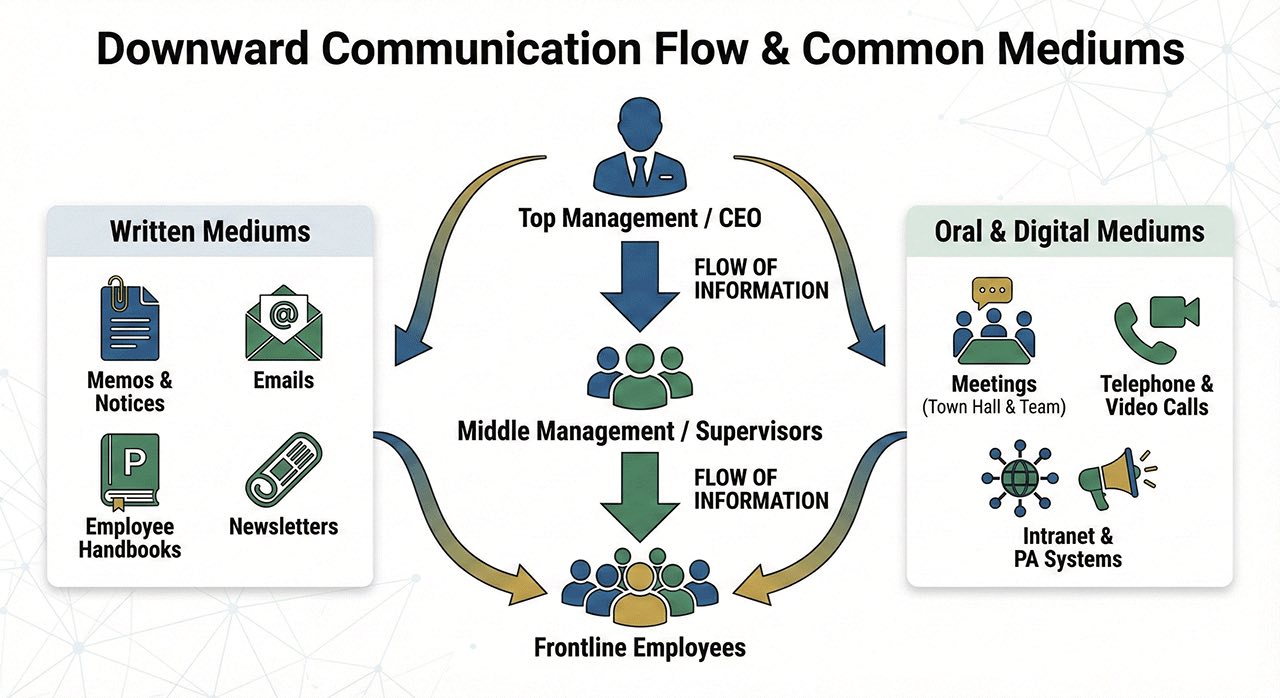
Knowing the elements is half the battle. The other half is choosing the right channel to deliver them. You wouldn’t use a loudspeaker to fire someone, and you wouldn’t whisper a fire alarm.
Written Methods
Written communication is great for complex or legal information. It provides a permanent record.
- Memos: These are classic internal documents used for short, specific announcements. If you are unsure about the format, we have a guide on what is a business memo.
- Notices: Best for general announcements like holiday closures or safety drills.
- Emails: The modern workhorse for daily instructions.
Oral Methods
Oral communication allows for immediate feedback and emotional connection.
- Meetings: These are essential for explaining “Job Rationale” and “Indoctrination.” A face-to-face discussion clears up confusion instantly. For tips on running them well, take a look at our company meeting guide.
- Telephone: Good for quick, personal check-ins.
Advantages and Disadvantages
Like any tool, downward communication has its pros and cons.
On the positive side, it is excellent for maintaining organizational discipline. It ensures that critical decisions made at the top are implemented quickly at the bottom. It clarifies who reports to whom.
On the other hand, it has significant drawbacks. The biggest issue is the distortion of information. By the time a message reaches the bottom, it might be completely different from what the CEO intended. Also, it can often be slow.
Furthermore, excessive downward communication can lead to “information overload.” Employees might tune out if they are bombarded with too many emails. For a balanced view, you can explore the advantages and disadvantages of downward communication in our separate article.
How to Make It Effective
So, how do you stop the distortion? How do you ensure your instructions and rationale land correctly?
First, keep it simple. Avoid corporate jargon that confuses regular employees. Speak their language.
Second, use a multi-channel approach. Don’t just send an email. Send the email and follow it up with a brief meeting. This redundancy ensures the message is seen and understood.
Third, and most importantly, encourage feedback. Even though the flow is downward, you must create a loop where employees can ask questions. If they are afraid to ask for clarification, your communication has failed. We have a dedicated strategy guide on how can you make downward communication effective that offers actionable tips.
FAQ: Essential Elements
What is the most important element of downward communication?
While all five are vital, Job Rationale is often considered the most critical for long-term motivation. People need to know why they are working.
How does this differ from upward communication?
Downward moves from superiors to subordinates (directives). Upward moves from subordinates to superiors (feedback/reports). To see the full comparison, read about upward vs downward vs horizontal communication7.
Can downward communication happen via video?
Absolutely. In the remote work era, video messages from leadership are a powerful tool for Indoctrination and Job Rationale.
Conclusion
Mastering the essential elements of downward communication is not about being a dictator. It is about being a clearer, more empathetic leader.
When you effectively combine clear instructions with a strong rationale, fair procedures, honest feedback, and inspiring indoctrination, you transform your workforce. You move from a culture of compliance to a culture of commitment.
Take a look at your current communication strategy. Are you just giving orders? Or are you explaining the “why” and building the culture? The difference will show in your results.
Frequently asked questions
What if an employee understands the task but disagrees with the job rationale?
Disagreement doesn’t mean the work stops. Provide the rationale clearly and explain how it connects to organizational goals. Listen to their concerns—they may spot issues you missed. However, make it clear that understanding the ‘why’ is separate from execution. The task still needs to be completed, even if they have reservations about the reasoning.
Should I give feedback only during formal performance reviews?
No. Formal reviews are important, but immediate verbal feedback is often more effective. Employees need timely corrections and praise to stay on track. Wait too long, and the moment loses impact. Aim for regular check-ins—weekly or monthly—alongside annual reviews. This keeps performance aligned throughout the year.
How do I communicate job instructions without micromanaging?
Be specific about the outcome and deadline, but leave room for how employees get there. For example, instead of ‘Call these 50 leads in this order,’ say ‘Generate 50 qualified leads by Friday using your preferred outreach method.’ This gives clear direction while respecting their autonomy and expertise.
Can downward communication be too frequent and overwhelm employees?
Yes. Constant messages create noise and reduce clarity. Prioritize what truly needs downward flow—critical instructions, policy changes, and strategic direction. Use multiple channels (email, meetings, handbooks) based on urgency. Less frequent, well-structured communication is more effective than daily information overload.
What if middle managers aren’t passing information down accurately?
This is the ‘telephone game’ problem. Combat it by using multiple channels—written directives, town halls, and direct team meetings. Ask managers to confirm understanding before they communicate further. Provide them with talking points or scripts for sensitive messages. Spot-check by asking frontline employees what they understood.