


A business letter is formal written communication between organizations or professionals for an official purpose. A personal letter is an informal letter between people who share a personal connection. The core difference is formality and purpose: business letters document transactions and create legal records, while personal letters maintain relationships.
What is the difference between a personal and business letter?
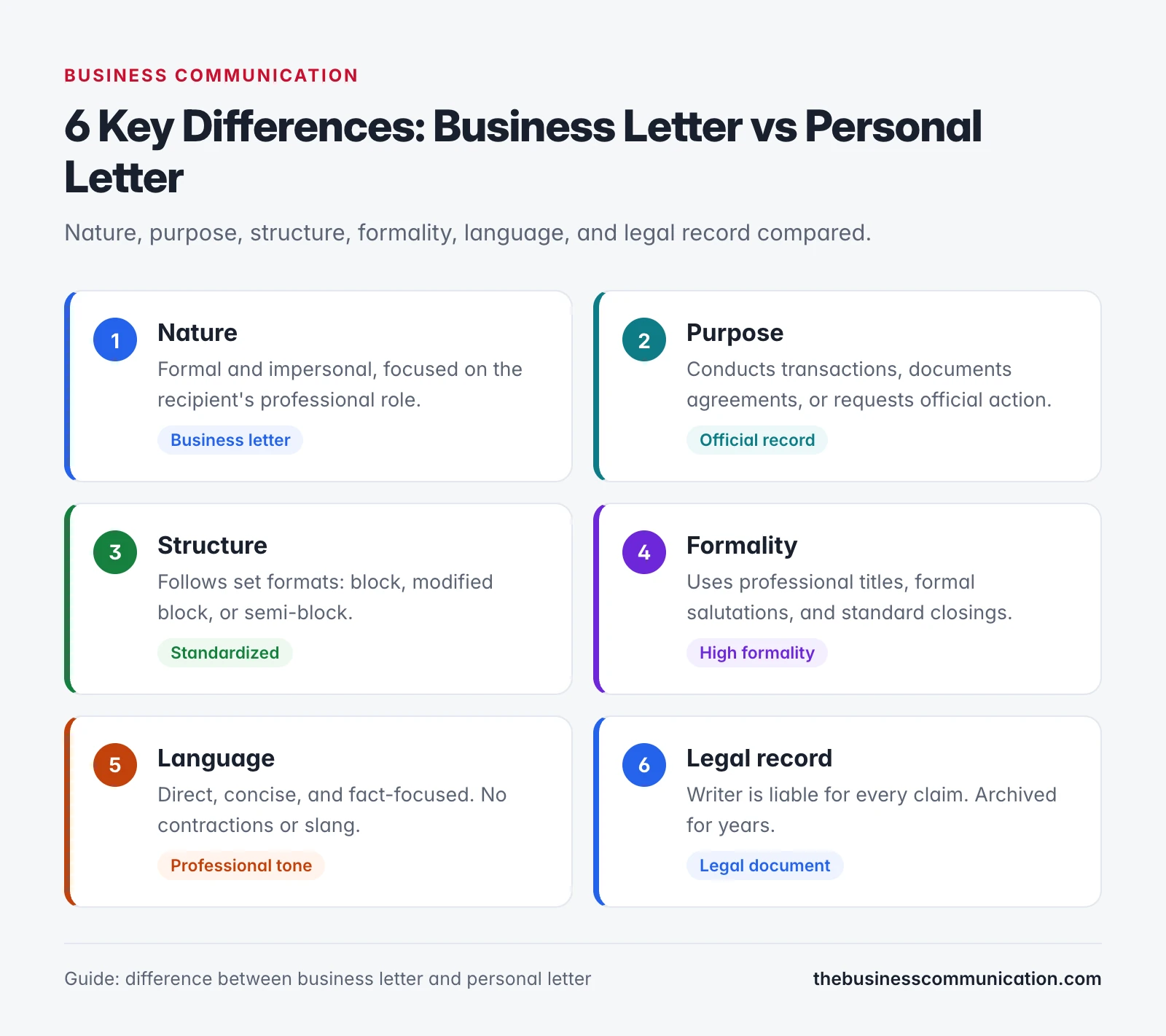
Six key areas define the difference between business letter and personal letter: nature, purpose, structure, formality, language, and legal standing.
- Nature: A business letter is impersonal and formal. It addresses the recipient’s professional role, not their personality. A personal letter is warm and shaped by your relationship with the reader.
- Purpose: Business letters conduct transactions, document agreements, file complaints, or request official action. Personal letters share news, express sympathy, or simply keep a friendship alive.
- Structure: Business letters follow recognized formats such as block, modified block, or semi-block layout. Every element has a set place. Personal letters need no formal structure at all.
- Formality: Business letters use professional titles, formal salutations such as “Dear Ms. Thompson,” and standard closings such as “Sincerely.” Personal letters use first names, nicknames, and closings such as “Love” or “Take care.”
- Language: Business letters use direct, concise, fact-focused language. Contractions, slang, and emotional appeals have no place in them. Personal letters welcome all three.
- Legal record: A business letter is a legal document. According to Lumen Learning’s professional communication guide, the writer can be held liable for anything stated in it, and organizations may retain business letters for years. A personal letter carries no legal obligation.
What is a business letter?
A business letter is a formal written communication exchanged between organizations, professionals, or individuals acting in an official capacity. You use it to communicate with suppliers, customers, banks, and other external parties about professional matters.
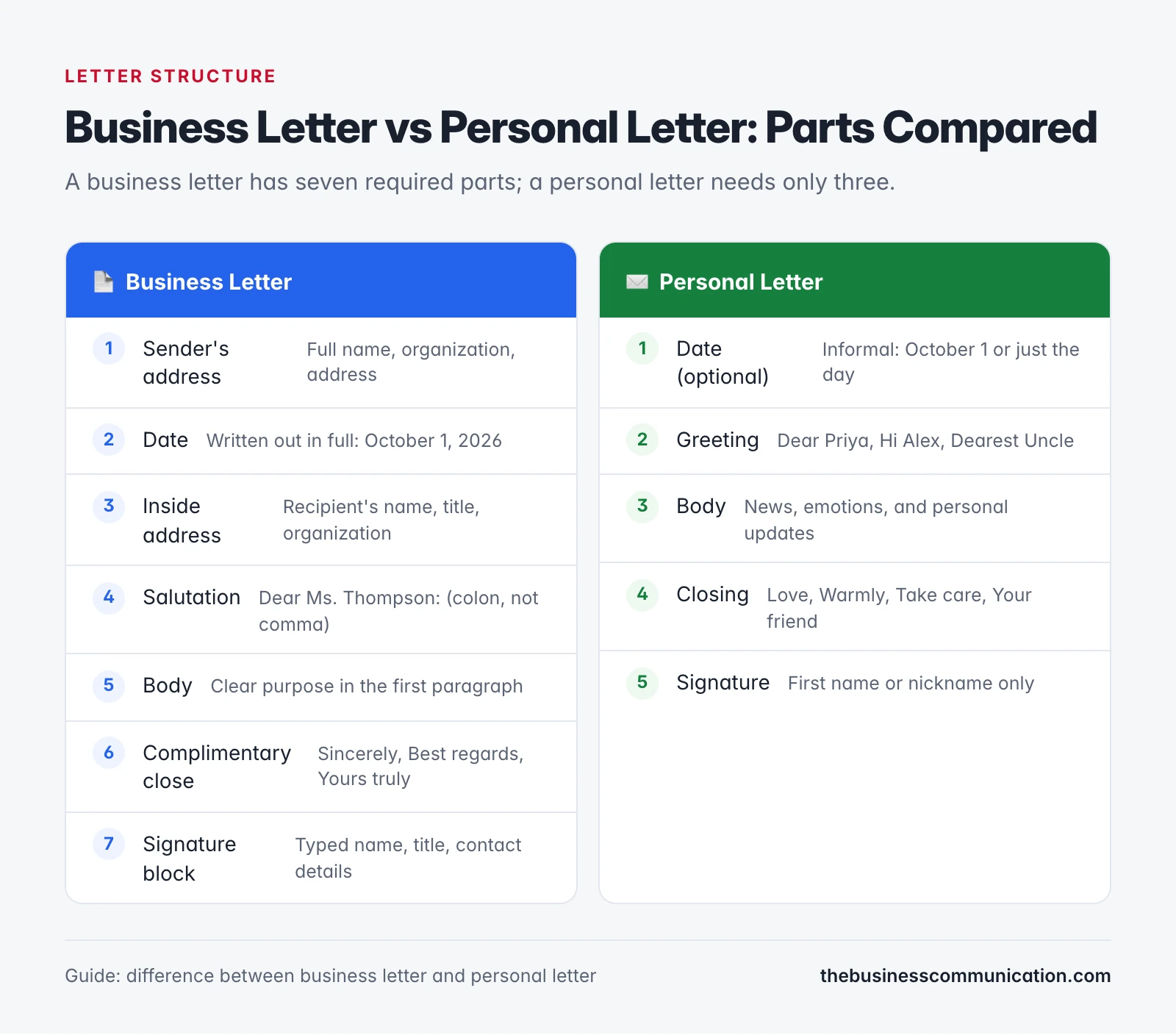
These letters follow standardized business letter formats such as block, modified block, and semi-block. Each format dictates the placement of every element: sender’s address, date, inside address, salutation, body, complimentary close, and signature block. This consistency helps recipients find information quickly and route letters to the right department.
What sets a business letter apart from most written communication is that it creates a legal record. Unlike a memo or an email, a signed letter can serve as evidence in a contractual dispute. Every claim must be accurate because you may be held to it.
Standardized conventions mean a complaint letter sent to a supplier in Dhaka follows the same basic rules as a purchase order sent to a manufacturer in London. That shared structure makes written business communication work between strangers in different industries and countries.
For a full breakdown, see our guide to the definition and importance of business letters.
What is a personal letter?
What does a personal letter mean? It is an informal written communication sent to family members, friends, relatives, teachers, or other individuals with whom you share a personal connection. The focus is on relationship, personal expression, or life updates rather than conducting transactions.
Unlike business letters, personal letters have no mandatory formatting rules. You can organize content however feels natural, skip formal headers, and write in a conversational style that reflects your personality. A handwritten note on personal stationery and a typed letter on plain paper are both acceptable.
You might write to share news, express sympathy after a loss, congratulate a friend on a new job, or simply stay in touch with a cousin who moved abroad. Personal letters favor warmth over efficiency and authenticity over formal convention.
Personal letters carry no legal weight. You can write freely without worrying that your words will be used as evidence.
You can also write at length, unbothered by the pressure to respect the reader’s time in the way a business letter demands. A grandparent enjoys a lengthy update; an insurance company does not.
Business letter vs personal letter: comparison table
The nine-point comparison below puts the difference between business letter and personal letter in a single view. Use it as a quick reference before you write.
| Element | Business Letter | Personal Letter |
|---|---|---|
| Nature | Formal, impersonal, professional | Informal, warm, personal |
| Purpose | Conduct business, request action, document agreements | Maintain relationships, share emotions, connect personally |
| Structure | Follows set formats: block, modified block, semi-block | No mandatory structure; flexible layout |
| Tone | Formal, direct, objective | Conversational, emotional, subjective |
| Salutation | Dear Mr./Ms./Dr. [Surname], Dear [Title] | Dear [First Name], Hi [Name], My dear [Name] |
| Language | Direct, concise, fact-focused; no contractions or slang | Expressive, detailed, relationship-focused; contractions welcome |
| Closing | Sincerely, Best regards, Yours truly | Love, Warmly, Your friend, Take care |
| Length | Brief; ideally one page | Variable; can run several pages |
| Legal record | Archived for legal compliance, auditing, and dispute resolution | Kept for sentimental reasons or discarded; no legal obligation |
Sample business letter
Here is a short business complaint letter in block format. All names and organizations are fictional and used for illustration only.
The letter opens with a subject line, states the problem in the first paragraph, and makes a specific request in the second. The formal closing and signature block, including a job title, are standard business letter conventions.
Sample personal letter
Here is a personal letter between two friends. All names are fictional and used for illustration only.
No subject line, no inside address, no formal title. The casual greeting, personal news, and warm closing all mark this as a personal letter. The tone is relaxed and the content is entirely about the friendship.
Is this the same as formal letter vs informal letter?
Yes. The terms “formal letter” and “informal letter” used in school and exam contexts describe the same distinction as “business letter” and “personal letter.” The terminology differs by context: schools say formal and informal, while professional writing instruction says business and personal.
In school exams, a formal letter follows business letter conventions: inside address, formal salutation, professional tone, and a standard closing. An informal letter follows personal letter conventions: casual greeting, conversational tone, and a warm closing. If your exam paper says “write a formal letter,” write it as a business letter.
There is also a middle category called the semi-formal letter. Semi-formal letters go to people you know professionally but not intimately, such as a mentor or a long-standing client. The structure follows business letter format, but the tone is warmer than a letter to a complete stranger.
This is essentially the personal business letter discussed in the next section.
What is a personal business letter?
Personal business letters are a hybrid: an individual writing formally to an organization or a business contact, using business letter structure but addressing a personal-professional matter. Examples include a thank-you letter to a mentor or a reference letter for a friend applying to graduate school.
Perspective is the key distinction. In a standard business letter, a company communicates with another party. In a personal business letter, you write on your own behalf to a company or professional contact. The format follows business letter conventions: inside address, formal salutation, and a typed signature block.
Tone is where rules ease a bit. A thank-you to a mentor allows a sentence or two of genuine warmth. A reference letter for a close friend reads more personally than a standard HR reference.
Keep the structure formal, but let the language reflect the real relationship. For step-by-step guidance, see our post on how to write a business letter.
When to use each letter type: decision framework
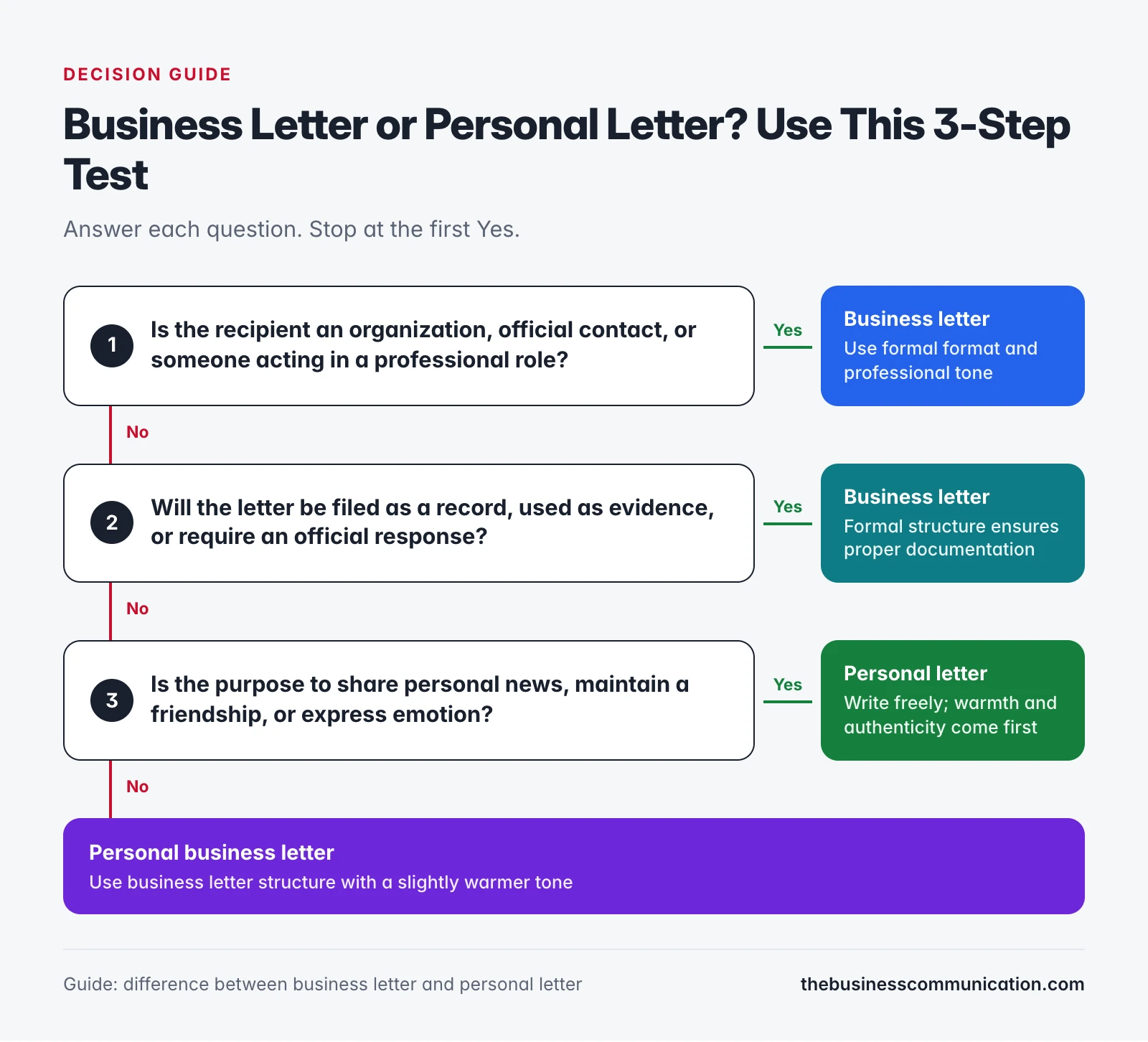
If you are unsure which type to write, work through these three questions.
- Who is the recipient? Are you writing to an organization, a business contact you have never met personally, or someone acting in an official capacity? If yes, use a business letter. If you are writing to a friend or a family member you know only personally, use a personal letter.
- What happens to the letter after it is sent? Will it be filed, routed through a department, or kept as evidence of an agreement? If so, it is a business letter. Will it be read, appreciated, and possibly kept as a keepsake? That is a personal letter.
- Does it need a formal reply or action? Business letters typically require an official response, a signature, or a specific outcome. Personal letters invite a reply but do not require one. If a deadline or a defined result is expected, treat the letter as business.
One quick test: if the recipient could forward your letter to their legal department or HR team without you feeling uncomfortable, it is a business letter. If you would be mortified to see it read aloud at a board meeting, it is personal.
Personal business letters are the exception: you are writing in your own name to an organization or a professional contact. In those cases, follow business letter format while letting the tone reflect your real relationship.
See our guide on the difference between business letters and email if you are deciding between formats.
Common mistakes and how to avoid them
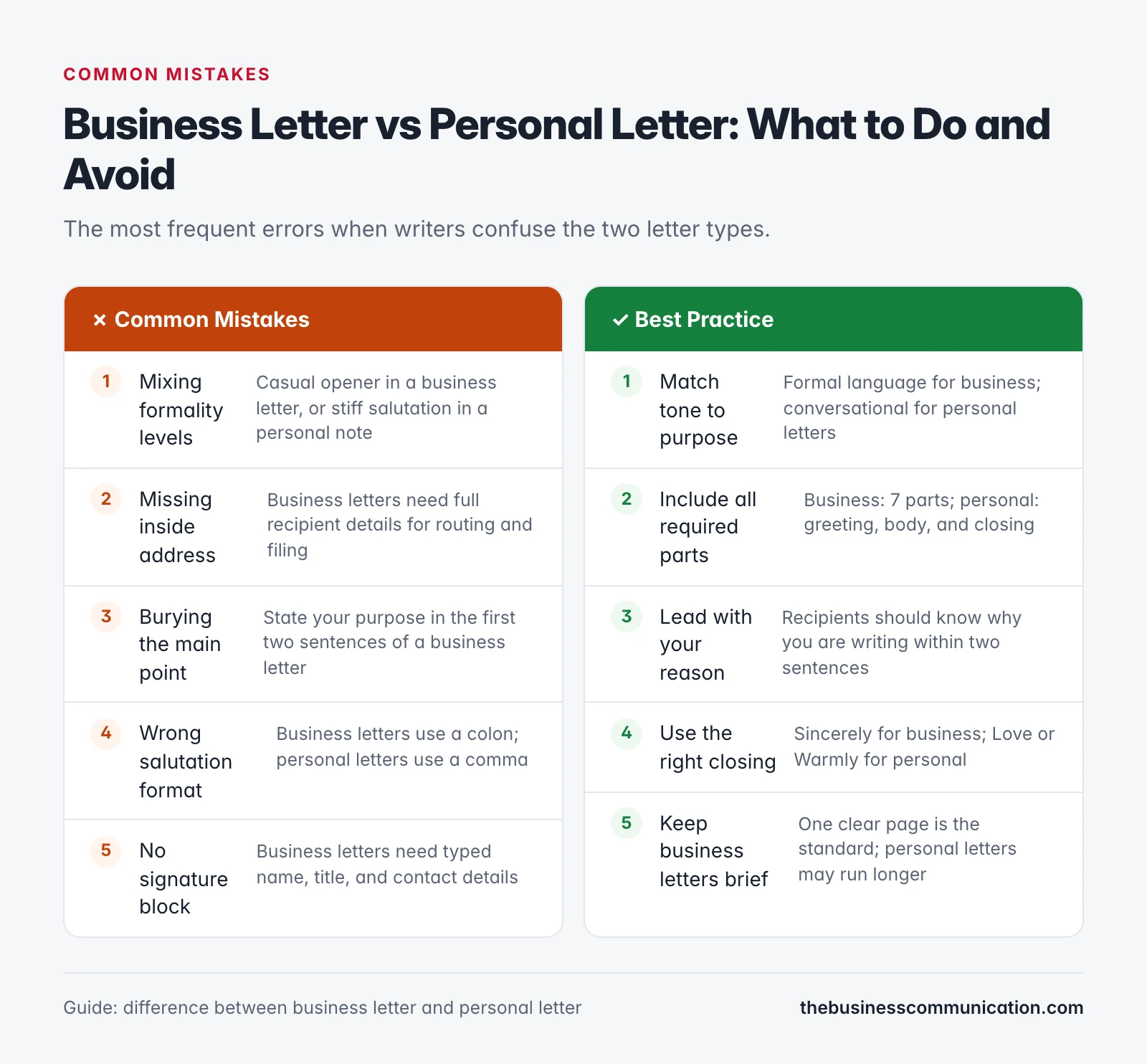
Mixing formality levels is the most common error. Writing “Hey there!” in a business letter or “To Whom It May Concern” in a note to your cousin creates tonal confusion. Match your language to your purpose and your relationship with the reader, from the opening word to the closing signature.
Another mistake is ignoring structure when it matters. Skipping the inside address, forgetting the date, or omitting contact information undermines professionalism. Recipients need every component in place so they can file the letter correctly and reply to the right person.
Personal letters can be structurally casual, but they should still be organized enough to follow.
Wrong salutations damage credibility quickly. Addressing a senior contact by their first name in a formal business letter signals poor judgment. Calling your childhood friend “Mr. Hossain” in a birthday card sounds bizarre.
When in doubt about a business contact, lean toward formality. You can adjust in future letters if they sign their replies with just a first name.
Many writers fail to state their purpose clearly in business letters. Your recipient should understand why you are writing within the first two sentences. Writers often bury the main point out of misplaced politeness, which wastes the reader’s time.
Lead with the request, then provide supporting details. Personal letters can wander freely; business letters cannot.
Length is a common source of confusion. Business letters should be brief and clear, ideally one page. The goal is not brevity for its own sake, but eliminating anything that does not help the reader understand and respond to your message.
Personal letters can run for several pages if the relationship and context call for it.
Exam practice: try it yourself
If you are studying for a business communication or English exam, these two prompts will help you practice. Write your response and then check it against the conventions in this guide.
- Business letter prompt: Write a complaint letter to a telecommunications company explaining that your broadband service has been unreliable for three weeks. Request a refund for the affected period and state a deadline for resolution. Use block format.
- Personal letter prompt: Write a letter to an old school friend you have not contacted in two years. Share one piece of news from your life and ask about theirs. Use an appropriate greeting and closing for a personal letter.
After writing each letter, ask yourself: does the business letter state its purpose in the first sentence? Does the personal letter use a warm, appropriate greeting and closing? If both answers are yes, you have it right.
Frequently asked questions
What if I don’t know the recipient’s name for a business letter?
Use a generic salutation such as “Dear Hiring Manager,” “Dear Sir or Madam,” or “To Whom It May Concern.” A better approach is to call the organization and ask for the correct name and title before writing.
According to Purdue OWL’s business letter guidelines, if you are unsure of the recipient’s gender, use a nonsexist salutation: their job title followed by their full name. For example, “Dear Operations Manager Alex Hossain” works well and avoids guessing. Avoid casual openings like “Hi there” in formal business letters.
Can I mix business letter format with a personal note at the end?
Yes, but use restraint. A brief personal line after your formal closing, such as “P.S. I hope your family is well,” is acceptable when writing to someone you know. Keep it to one sentence.
Extended personal commentary weakens the letter’s authority and can confuse the recipient about whether the message is professional or personal.
Should I handwrite or type a business letter today?
Type business letters unless the recipient has specifically requested a handwritten note. Typed letters look professional, are easier to read, and create a clear record. Handwriting works well for personal letters and short thank-you notes, where it adds warmth and shows extra effort.
Why might my complaint letter get ignored by a company?
Common reasons include an unclear opening, missing contact information, or vague details that make it hard for staff to route the letter internally. State your complaint and your desired outcome in the first paragraph.
Include specific dates and reference numbers, and address the letter to the correct department. A well-structured complaint letter signals that you are serious and expect a formal response.
Is it ever appropriate to send a personal letter for a professional matter?
No. Using personal letter conventions for professional matters risks appearing unprofessional and creates problems with documentation and routing. Even if you know the recipient well, professional matters require business letter format to ensure proper record-keeping. Reserve personal tone for correspondence that has no official purpose or legal implication.
What are the four types of business letters?
Business letters fall into four types by purpose. Inquiry or request letters ask for information, quotes, or action. Order letters confirm purchases or agreements. Complaint or adjustment letters report a problem and seek resolution. Sales or promotional letters present an offer to a potential client.
Other sub-types exist, such as cover letters, reference letters, and resignation letters, but these four cover most professional situations.
What are the three types of letters?
By formality, letters fall into three types: formal, semi-formal, and informal. Formal letters follow business letter conventions: set structure, professional tone, and an official purpose. Informal letters are personal letters written to people you know well.
Semi-formal letters fall between the two. They use business letter structure but adopt a warmer tone, often written to a mentor or a long-standing professional contact.
2 Comments
Good day.
Can we include this in our book? Rest assured, proper citation and referencing will be observed.
Thanks.
I read this blog it’s just a super blog, I am really happy to read this blog,