

Close Menu
The Business CommunicationThe Business Communication
    What's Hot

    Problems of Electronic Communication In Business

    October 23, 2025

    Objectives of Business Communication: Strategic Goals for Modern Organizations

    October 18, 2025

    Leadership Styles That Encourage Employees to Speak Up

    October 11, 2025
    Facebook X (Twitter)
    The Business CommunicationThe Business Communication
    Button
    • Basics
      1. Introduction
      2. Communication Skills
      3. Modern Communication
      4. View All

      Objectives of Business Communication: Strategic Goals for Modern Organizations

      October 18, 2025

      Factors influencing the meaning of business communication

      May 20, 2025

      Scope of communication

      April 6, 2025

      The Strategic Role of Communication in Management: Driving Organizational Success

      March 27, 2025

      8 Ways To Improve Your Listening Skills

      September 17, 2025

      Various Styles Reading or Techniques of Reading

      March 30, 2025

      What Is Communication Style | Classification Of Communication Style

      May 27, 2023

      Meaning Of Cross-Cultural Communication

      November 25, 2022

      Problems of Electronic Communication In Business

      October 23, 2025

      Advantages and Disadvantages of Email in Modern Business Communication

      June 28, 2025

      What Is Communication Satellite?

      December 24, 2024

      What Is Multimedia In Communication || Importance Of Multimedia

      October 4, 2024

      Problems of Electronic Communication In Business

      October 23, 2025

      Objectives of Business Communication: Strategic Goals for Modern Organizations

      October 18, 2025

      Leadership Styles That Encourage Employees to Speak Up

      October 11, 2025

      Upward Communication Case Study: Examples from Tech, Healthcare & Education

      October 10, 2025
    • Forms of Communication
      • Oral Communication
      • Non-Verbal Communication
      • Report Writing
    • Written Communication
      1. Letter Writing
      2. Circular Letter
      3. inquiry letter
      4. Ultimatum Letter
      Featured
      Letter Writing

      How to Write an Effective Circular Letter: Step by Step Guide

      By Masudur RashidSeptember 27, 2025
      Recent

      How to Write an Effective Circular Letter: Step by Step Guide

      September 27, 2025

      Difference Between Official Letter and Business Letter: Key Distinctions Explained

      August 18, 2025

      College Admission Inquiry Email – Samples

      August 16, 2025
    • In Business
      1. Company Meeting
      2. Secretarial Functions
      3. View All

      Meaning of Company Secretary | Appointment of Company Secretary

      May 6, 2025

      Participants Responsibilities in Meeting

      January 28, 2025

      How to Facilitate Productive Project Meetings

      January 22, 2025

      The Ultimate Company Meeting Guide: Definition, Types, Process, Advantages & Disadvantages

      October 22, 2024

      Functions of a Private Secretary

      August 12, 2025

      What Is Organizational Communication – Types of Organizational Communication

      December 7, 2024

      Qualifications of a Private Secretary

      May 5, 2024

      What is Secretary? Types of secretary

      March 6, 2024

      Problems of Electronic Communication In Business

      October 23, 2025

      Objectives of Business Communication: Strategic Goals for Modern Organizations

      October 18, 2025

      Leadership Styles That Encourage Employees to Speak Up

      October 11, 2025

      Upward Communication Case Study: Examples from Tech, Healthcare & Education

      October 10, 2025
    • Internal Communication
      1. Downward Communication
      2. Horizontal Communication
      3. Upward Communication
      4. View All

      Essential Elements of Downward Communication: A Complete Guide for Managers

      September 13, 2025

      Types of Vertical Communication: Upward and Downward Communication Explained

      May 18, 2025

      What is downward communication? [Objectives and Methods]

      January 1, 2024

      Advantage And Disadvantages of downward communication

      December 23, 2023

      What is Horizontal Communication: Definition, Examples & Importance

      January 21, 2025

      Importance of Horizontal Communication (With Real-Life Examples)

      November 26, 2023

      Upward vs Downward vs Horizontal Communication: Key Differences

      December 24, 2022

      Advantages and Disadvantages of Horizontal Communication (With Real Examples)

      October 15, 2022

      Leadership Styles That Encourage Employees to Speak Up

      October 11, 2025

      Upward Communication Case Study: Examples from Tech, Healthcare & Education

      October 10, 2025

      Types of Vertical Communication: Upward and Downward Communication Explained

      May 18, 2025

      Psychological Safety & Upward Communication: Building Trust at Work

      October 8, 2024

      Problems of Electronic Communication In Business

      October 23, 2025

      Objectives of Business Communication: Strategic Goals for Modern Organizations

      October 18, 2025

      Leadership Styles That Encourage Employees to Speak Up

      October 11, 2025

      Upward Communication Case Study: Examples from Tech, Healthcare & Education

      October 10, 2025
    The Business CommunicationThe Business Communication
    Home » Written Communication » What is a Report? Definition, Format, Types & Examples

    What is a Report? Definition, Format, Types & Examples

    By Masudur Rashid1 Comment8 Mins Read Written Communication Report Writing
    Facebook Twitter Reddit WhatsApp Telegram Pinterest LinkedIn Email
    Share
    Facebook Twitter Pinterest WhatsApp Email

    Imagine you are a detective. You visit a crime scene, gather clues, analyze the evidence, and finally, you have to tell the chief what happened. You cannot just ramble on about the weather. You need a structured, factual account of the event.

    Well, that is exactly what a report is in the business world.

    Whether you are a student, a manager, or an engineer, you will write reports. It is inevitable. In fact, strong report-writing skills can set you apart from your peers. It shows you can think critically and communicate clearly.

    In this guide, we will break down the definition of a report, explore the standard format, and even give you some ready-to-use templates. Above all, we want to make this dry topic as easy as possible to digest.

    What is a Report?

    Let’s start with the basics. A report is a document that presents information in an organized format for a specific audience and purpose.

    Unlike an essay, which often focuses on argumentation and personal voice, a report focuses on facts. It is objective. It is precise.

    In a business setting, a report is a tool. Managers use it to analyze performance, track progress, and make decisions. Without reports, organizations would be flying blind. They wouldn’t know if they made a profit or if a project failed.

    Essentially, the main objectives of business reports are to provide information, analyze a problem, and recommend a solution. It is the fuel that keeps the corporate engine running.

    Essential Characteristics of a Good Report

    Not all documents are created equal. You might have seen reports that are confusing, messy, or just plain boring. To write a killer report, you need to focus on a few key characteristics.

    1. Precision and Accuracy

    A report must be accurate. If your data is wrong, your conclusion will be wrong. Consequently, the decision based on that report will be wrong. Always double-check your facts.

    2. Relevance

    Stick to the point. If you are writing a sales report, do not talk about the office cafeteria menu. Every sentence should contribute to the main objective.

    3. Reader-Orientation

    Who is reading this? Is it your boss? A client? The public? You must adapt your language to suit them. Avoid jargon if the reader is not an expert.

    4. Clarity and Conciseness

    Keep it simple. Use short sentences. Use headings. Break up big blocks of text. Your goal is to express, not to impress.

    Classifications: Types of Reports

    Reports come in all shapes and sizes. We can categorize them in several ways. Understanding these types helps you choose the right format for your needs.

    By Length

    This is the simplest classification.

    • Short Reports: These are usually informal. They might be one or two pages long. Memos and letter reports fall into this category. You can explore various forms of short reports to understand how they differ from formal documents.
    • Long Reports: These are formal and complex. They examine significant problems in detail.

    Knowing the difference between a short report vs long report is crucial because the structure changes completely. A long report needs a table of contents and an executive summary, while a short one usually does not.

    By Purpose

    This is where it gets interesting.

    • Informational Reports: These reports just provide data. They do not analyze or recommend. For instance, an annual business report often serves to inform shareholders about the company’s financial standing over the past year.
    • Analytical Reports: These go a step further. They present data and then analyze it to draw conclusions. A market report structure is a classic example. It doesn’t just list prices; it explains why prices are moving.
    • Special Reports: These are required by law or specific rules. For example, a director’s report is a statutory requirement for companies to share their state of affairs with stakeholders.

    The Standard Report Format (Structure)

    Now, let’s get to the meat of the matter. How do you actually structure a formal report?

    While formats can vary, most business reports follow a standard structure. This is often called the IMRAD approach (Introduction, Methods, Results, and Discussion) in academics, but business varies slightly.

    Here is the anatomy of a professional report:

    1. Title Page

    This is the face of your report. It should include the title, the name of the person it is submitted to, the name of the author, and the date.

    2. Executive Summary (or Abstract)

    This is the most important part for busy managers. It summarizes the entire report. It includes the problem, the analysis, and the final recommendation. Interestingly, many executives read only this section.

    3. Table of Contents (TOC)

    If your report is long, you need a map. A TOC helps readers find specific sections quickly.

    4. Introduction

    Here, you set the stage. What is the report about? Why was it written? What is the scope? You define the problem here.

    5. Methodology

    How did you get your data? Did you do a survey? Did you interview people? This section adds credibility to your findings.

    6. Body / Discussion

    This is the core. You present your findings and analyze them. Use headings, bullet points, and charts here. Make the data easy to read.

    7. Conclusion

    Pull everything together. What does the data mean? No new information should appear here. It is just a summary of your analysis.

    8. Recommendations

    This is the “So What?” section. Based on your conclusion, what should the company do? Be specific and actionable.

    9. References and Appendices

    List your sources. If you have huge charts or raw data, put them in the appendix so they don’t clutter the main text.

    Following these steps in writing a business report ensures you don’t miss any critical details.

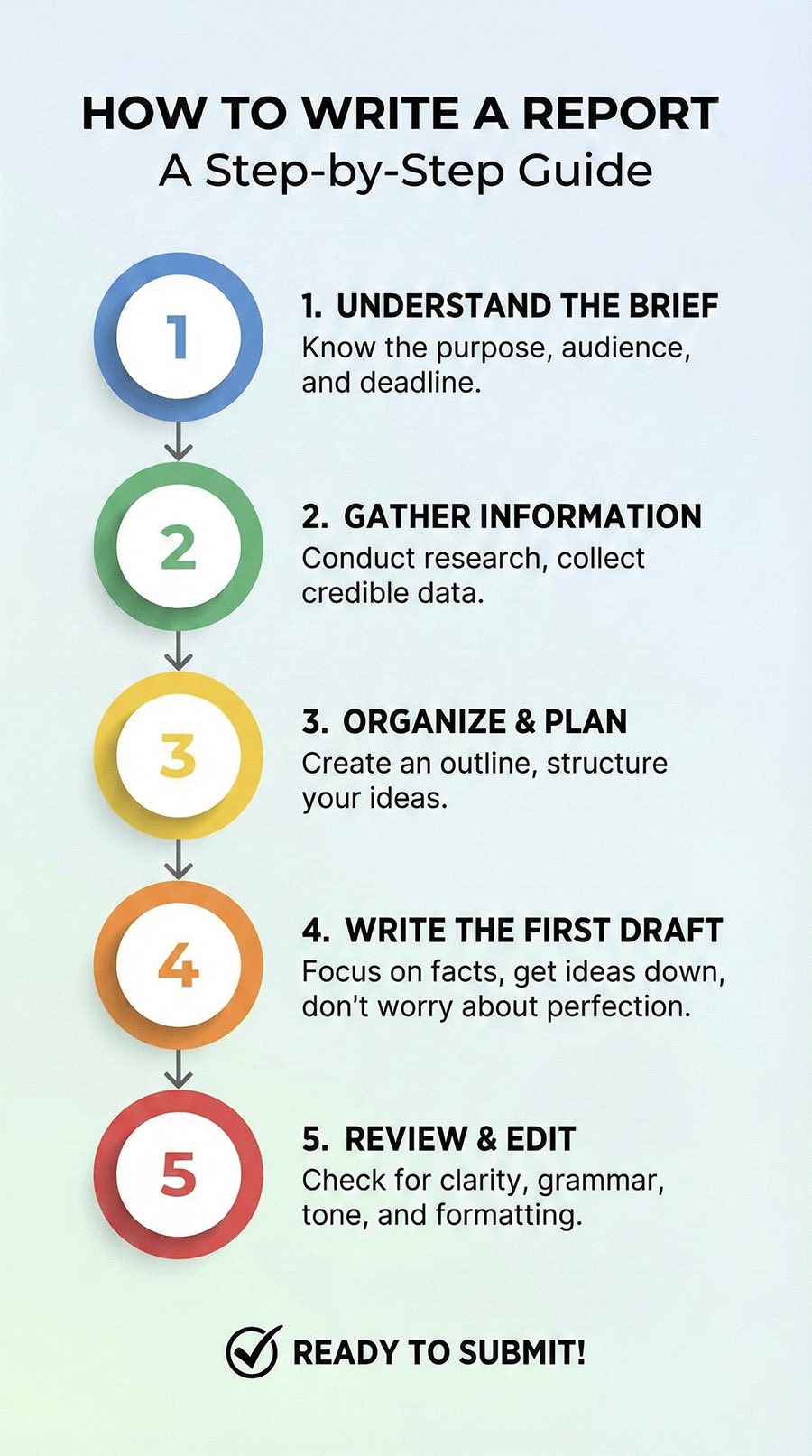
    How to Write a Report: A Step-by-Step Guide

    Writing a report can feel overwhelming. However, if you break it down, it becomes manageable.

    Step 1: Understand the Brief

    Before you type a single word, ask questions. What is the purpose? Who is the audience? When is it due?

    Step 2: Gather Information

    Do your research. Collect the facts. Make sure your sources are reliable.

    Step 3: Organize and Plan

    Create an outline. Decide what goes in the introduction and what goes in the body. This is the blueprint of your building.

    Step 4: Write the First Draft

    Just write. Don’t worry about grammar yet. Get your ideas down on paper. Focus on the facts.

    Step 5: Review and Edit

    Now, polish it. Check for spelling errors. Check the tone. Is it objective? Is it clear?

    HOW TO WRITE A REPORT

    3 Practical Report Templates

    To save you time, here are three simple templates you can copy and adapt.

    Template 1: Short Incident Report (Memo Format)

    To: [Recipient Name]

    From: [Your Name]

    Date: [Date]

    Subject: Incident Report – [Incident Name]

    Description of Incident:

    On [Date] at [Time], a [describe incident briefly] occurred at [Location].

    Action Taken:

    Immediate action was taken to [describe action]. The safety team was notified.

    Conclusion/Recommendation:

    It is recommended that [suggestion] to prevent future occurrences.

    Template 2: Weekly Progress Report

    Project Name: [Name]

    Week Ending: [Date]

    Prepared By: [Name]

    1. Summary of Achievements:

    • Completed task A.
    • Finalized design for B.

    2. Challenges/Issues:

    • Delay in receiving materials from vendor X.

    3. Plan for Next Week:

    • Begin testing phase.
    • Schedule meeting with client.

    Template 3: Simple Recommendation Report

    Title: Recommendation for [Topic]

    1. Introduction:

    The purpose of this report is to analyze [problem] and suggest a solution.

    2. Findings:

    Our analysis shows that [insert key data point]. Currently, the process is inefficient because of [reason].

    3. Options:

    • Option A: [Description]
    • Option B: [Description]

    4. Recommendation:

    Based on the analysis, we recommend Option A because it offers the best ROI.

    Frequently Asked Questions (FAQ)

    Q: What is the difference between an essay and a report?

    A: An essay presents an argument or opinion. Conversely, a report presents facts and information. Reports have headings and numbered sections, while essays usually flow in continuous paragraphs.

    Q: How long should a report be?

    A: It depends on the topic. A daily sales report might be one page. A feasibility report could be 100 pages. Always ask for the required length before you start.

    Q: Do I need to use formal language?

    A: Yes. Avoid slang. Avoid contractions (like “can’t” or “won’t”). Keep it professional.

    Q: What is a “Letter of Transmittal”?

    A: This is a polite letter you send along with a formal report. It basically says, “Here is the report you asked for.”

    Conclusion

    Report writing is not rocket science. It is a structured way of thinking.

    When you master this skill, you become a better communicator. You learn to look at data, find the story within it, and present it clearly.

    Whether you are writing a simple memo or a complex annual review, the principles remain the same. Be accurate. Be clear. Be relevant.

    Now that you have the knowledge and the templates, you are ready to write your next report with confidence.

    Report Characteristics report writing Waht is report?
    Share. Facebook Twitter Pinterest LinkedIn WhatsApp Reddit Email
    Previous ArticleMeeting Minutes: How to Write Effective Minutes (with Examples)
    Next Article Ultimatum Letter vs Warning Letter vs Demand Letter: Key Differences
    Masudur Rashid
    • Facebook
    • X (Twitter)
    • Instagram
    • LinkedIn

    👋 Hi, I am Masudur Rashid. I studied Management (Honors and Masters) but my real passion has always been Business Communication. Through this blog, I share simple tips, lessons, and resources to help students and professionals communicate with confidence.

    Related Posts

    Letter Writing 06 Mins Read

    How to Write an Effective Circular Letter: Step by Step Guide

    Letter Writing 06 Mins Read
    Letter Writing 09 Mins Read

    Difference Between Official Letter and Business Letter: Key Distinctions Explained

    Letter Writing 09 Mins Read
    Written Communication 06 Mins Read

    College Admission Inquiry Email – Samples

    Written Communication 06 Mins Read
    Letter Writing 07 Mins Read

    Letter of Adjustment (Reply to Complaint) – Guide & Examples

    Letter Writing 07 Mins Read
    View 1 Comment

    1 Comment

    1. Hidden girl on October 12, 2022 6:35 pm

      Very nice 👍🙂

      Reply
    Leave A Reply Cancel Reply

    This site uses Akismet to reduce spam. Learn how your comment data is processed.

    Subscribe to Updates

    Get the latest business communication news from TBC.

    By signing up, you agree to the our terms and our Privacy Policy agreement.

    Check your inbox or spam folder to confirm your subscription.

    Top Picks

    Objectives of Business Communication: Strategic Goals for Modern Organizations

    Have you ever watched a rowing team in action? Every member rows in perfect sync.…

    Factors influencing the meaning of business communication

    Communication would be the change connected with information, ideas, would like in addition to behavior…

    Scope of communication

    Scope of communication means the normal functioning area of this subject. Since communication is essential…

    The Strategic Role of Communication in Management: Driving Organizational Success

    Management is not just about making decisions. It is about communicating them effectively. You might…

    Welcome to TheBusinessCommunication.com, your guide to clear and effective business communication. Here you will find simple lessons on report writing, letters, meetings, oral and written communication, and modern tools like email or virtual meetings. Our mission is to make learning communication easy, practical, and fun, so you can apply it in your studies, career, and everyday life.
    We're social. Connect with us:

    Facebook X (Twitter) YouTube LinkedIn RSS
    Top Insights

    Problems of Electronic Communication In Business

    Objectives of Business Communication: Strategic Goals for Modern Organizations

    Leadership Styles That Encourage Employees to Speak Up

    Subscribe to Updates

    Get the latest business communication news from TBC.

    By signing up, you agree to the our terms and our Privacy Policy agreement.

    Check your inbox or spam folder to confirm your subscription.

    Copyright © 2025 TheBusinessCommunication. All Rights Reserved.
    • Home
    • About Us
    • Contact US
    • Our Authors
    • Privacy Policy
    • Terms and Conditions

    Type above and press Enter to search. Press Esc to cancel.