


Have you checked your phone today? You probably scrolled through social media, glanced at a news headline, or listened to a podcast on your way to work. We do this automatically.
However, we rarely stop to think about the massive system behind these daily habits. This system connects billions of people instantly. It shapes our opinions. It even decides what we buy for dinner.
This powerhouse is Mass Communication.
In this guide, we will break down exactly how this machine works. We will look at the process, the different types of media, and why it matters so much for modern business.
Whether you are a student or a marketing professional, understanding this system is your key to mastering the modern world.
Let’s dive in.
What Is Mass Communication?
In simple terms, mass communication is the process of creating, sending, and receiving information to a large audience.
It is not like chatting with a friend at a coffee shop. That is interpersonal communication.
Instead, mass communication is “one-to-many.” A single source, like a TV station or a newspaper, sends a message to millions of people at the same time.
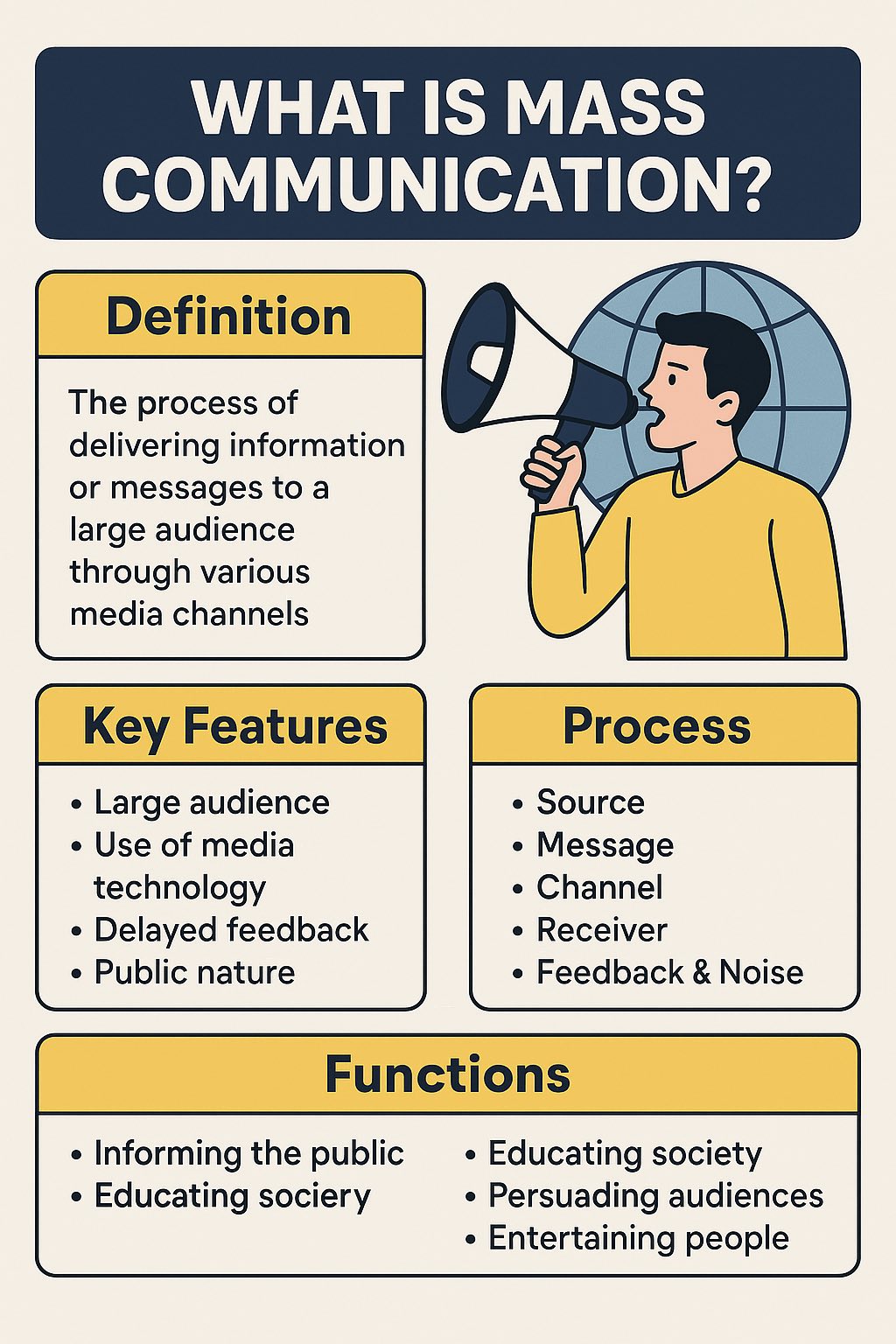
To make this happen, we need technology. This could be a printing press, a radio tower, or a server farm in Silicon Valley.
The core goal is simple: to inform, educate, and entertain a vast number of people simultaneously.
The 7 Key Characteristics of Mass Communication
How do you know if something is mass communication or just a group chat? There are seven specific traits that set it apart.
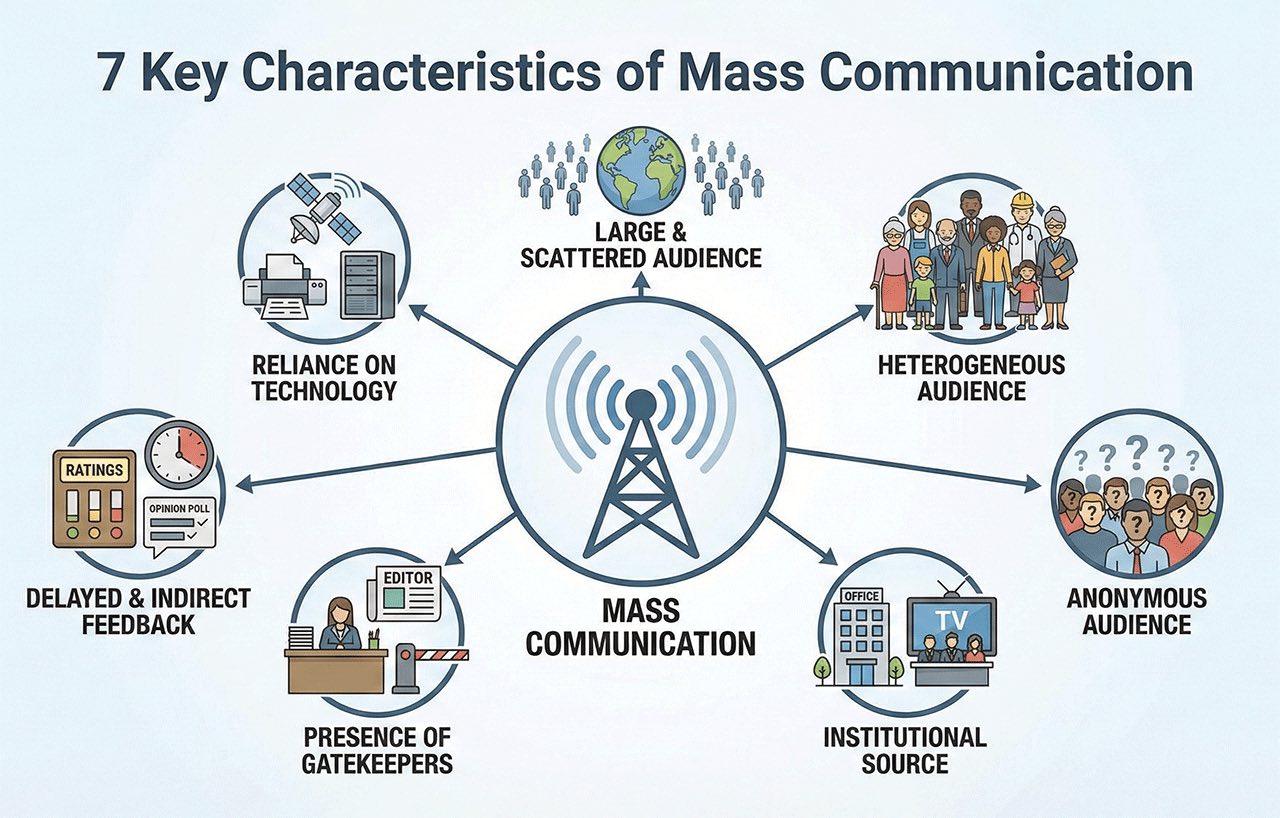
1. Large and Scattered Audience
The audience is massive. We are talking about thousands or millions of people. Furthermore, they are not in one room. One listener might be in New York, while another is in a small village in Bangladesh.
2. Heterogeneity
The audience is a mixed bag. They have different ages, religions, and political beliefs. A newspaper like The New York Times is read by CEOs and college students alike.
3. Anonymity
The sender does not know the receiver personally. To a TV network, you are just a statistic in a ratings report. There is a psychological distance between the creator and the consumer.
4. Institutional Source
The message rarely comes from one person. It usually comes from a complex organization. Even if you see one news anchor, there is a team of producers, editors, and technicians behind them.
5. Gatekeepers
This is a critical filter. A message does not flow freely. Editors, producers, or algorithms decide what gets published and what gets cut. They control the flow of information.
6. Delayed Feedback
In a conversation, feedback is instant. In mass media, it is traditionally slow. A TV producer has to wait for weekly ratings. However, digital media is changing this with instant comments and likes.
7. Reliance on Technology
You cannot do this with just your voice. You need a medium. If the power goes out or the internet cable is cut, mass communication stops immediately.
The Mass Communication Process: How It Works
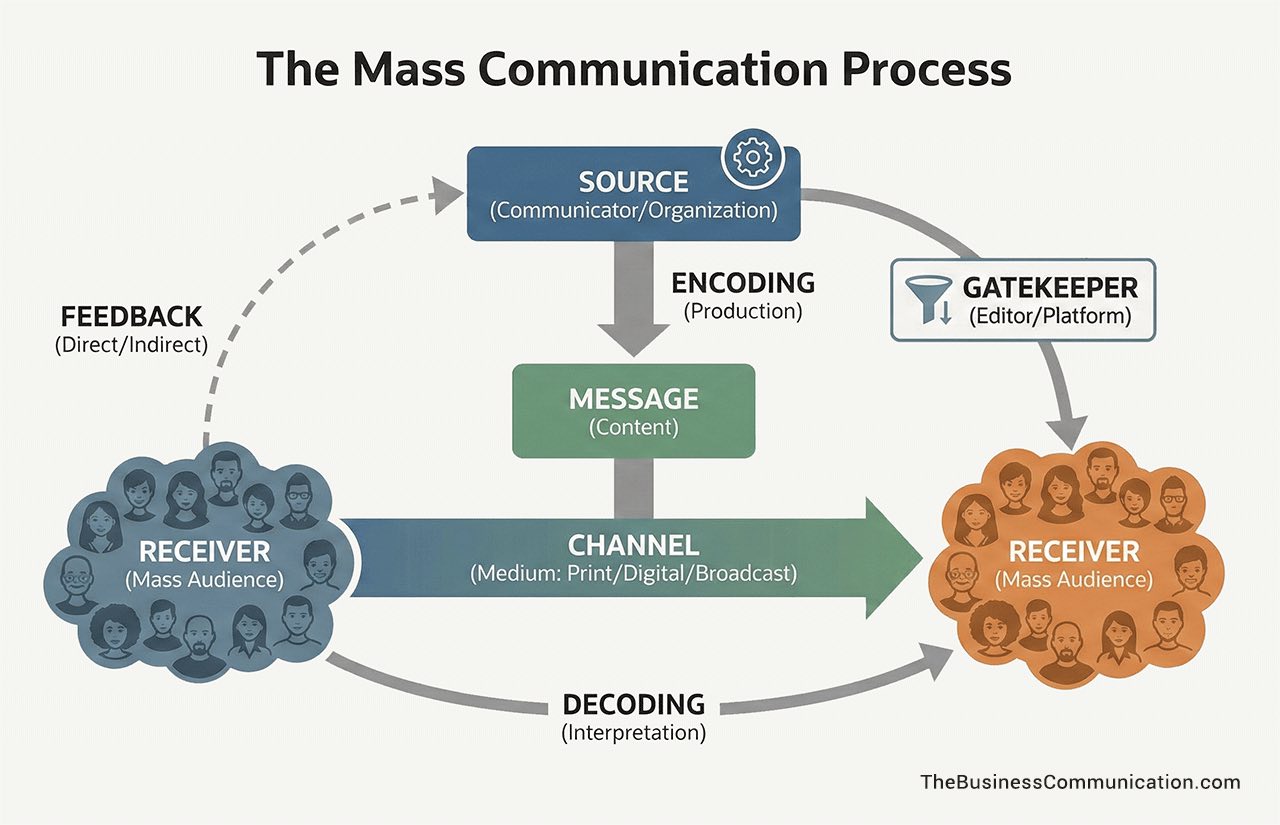
It feels like magic when news travels from London to Sydney in seconds. But it is not magic. It is a structured process.
Imagine a relay race. The baton (the message) is passed from one player to the next until it reaches the finish line.
Here is the step-by-step journey of a message:
Step 1: The Source (Ideation)
It starts with an organization or a professional communicator. They have an idea. This could be a breaking news story or a new product launch.
Step 2: Encoding
The idea is turned into a format. A journalist writes the text. A video editor cuts the footage. This makes the message ready for transmission.
Step 3: Gatekeeping
The message hits a checkpoint. An editor reviews the article. A legal team checks the ad. They filter out errors or risky content before it goes public.
Step 4: The Channel (Transmission)
The message travels through a medium. This could be airwaves, fiber optic cables, or paper. This is the bridge between the sender and the receiver.
Step 5: Decoding
The audience receives the message. They read the text or watch the video. They interpret the symbols back into thoughts in their own minds.
Step 6: Feedback
The audience reacts. They might buy the product, write a letter to the editor, or post a comment online. This closes the loop.
The 4 Primary Functions of Mass Communication
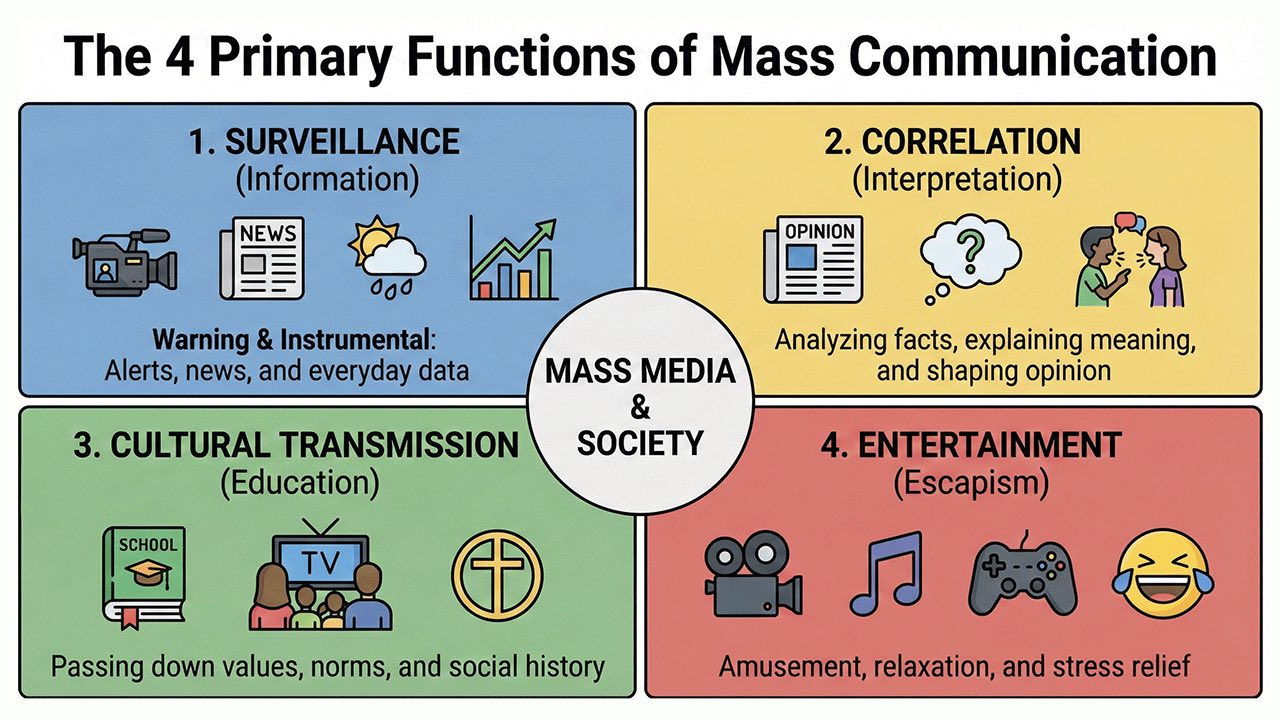
Why do we consume so much media? Sociologists have identified four main jobs that media performs for society.
1. Surveillance (The Watchdog)
Media acts as the eyes and ears of society. It scans the horizon for danger. When the news warns you about a hurricane or a stock market crash, it is performing surveillance. It helps us survive.
2. Correlation (The Interpreter)
Facts alone are confusing. Media helps interpret them. Editorials and blogs explain why something happened and what it means for you. This helps society reach a consensus.
3. Cultural Transmission (The Teacher)
Media passes down values from one generation to the next. Movies and books teach us what is “right” and “wrong” in our culture. It helps socialize us without us even realizing it.
4. Entertainment (The Escapism)
Life is stressful. We need a break. Mass media provides amusement and relaxation. Whether it is a comedy show or a viral video, entertainment is often the most popular function.
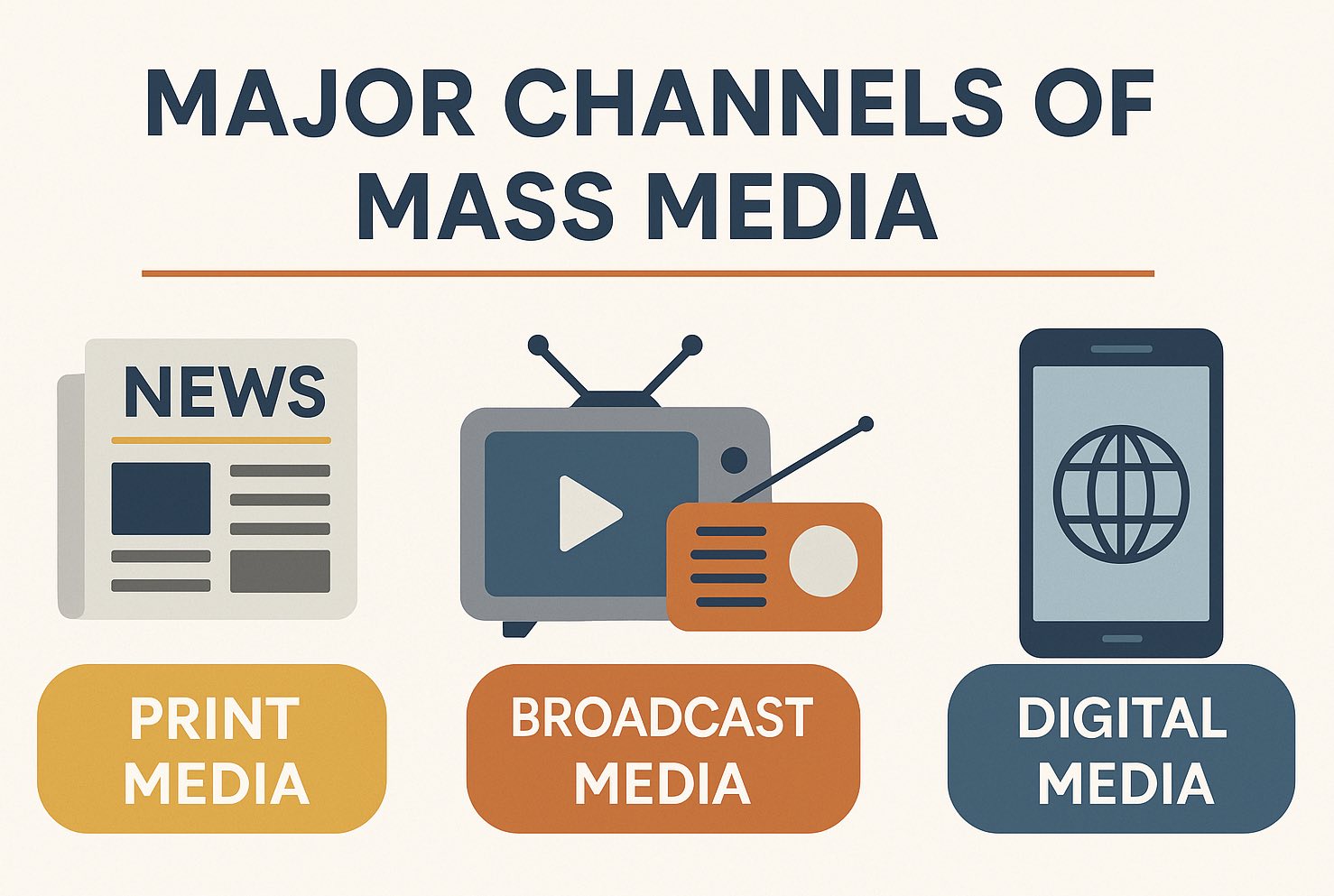
Types of Mass Media: Major Channels
We classify mass media into three main categories. Each has its own strengths and weaknesses.
Mass media are the channels (newspapers, radio, television, websites, social platforms) used to reach a large audience at once; mass communication is the process of sending messages through them.
The channels are also grouped as traditional media (print and broadcast) and modern media (digital platforms such as websites, blogs and social networks). Traditional media tends to focus on structured, edited content, while modern media puts speed and interaction first.
1. Print Media
This is the oldest form. It includes newspapers, magazines, books, and journals.
- Pros: It is highly credible and tangible. It allows for deep, detailed reading.
- Cons: It is slow. The news is already a day old by the time you read the paper.
- Also useful: It can be read without an internet connection and kept for later reference. Magazines suit in-depth features, journals suit research and technical content, and brochures serve promotional purposes.
- Other limits: Its reach is smaller than digital media, and printing and distribution add cost.
2. Broadcast Media
This era brought sound and visuals. It includes Radio and Television.
- Radio: Portable and accessible. Great for rural areas and emergency alerts.
- Television: Combines audio and visual for high emotional impact. It creates a shared cultural experience.
- Pros: Reaches millions instantly. High emotional engagement.
- Cons: Expensive to produce. Feedback is limited.
- Also useful: Appeals across age groups and backgrounds, and radio works well for educational campaigns.
- Other limits: Broadcasters choose what is aired, so coverage can reflect media bias.
Satellite television: benefits and limits
Satellite television sends programmes from a ground station to a communication satellite, which relays them back to dishes across a very wide area. One channel can therefore reach viewers in many countries at the same time.
| Benefits | Limits |
|---|---|
| Wide coverage: viewers can follow international news and world affairs from home | One-way medium: viewers have little direct way to respond |
| Business and market programmes on economics, investment and stock markets | Cultural concern: critics argue that channels from a few large media-producing countries can dominate other audiences (the “cultural imperialism” or “media imperialism” debate) |
| Educational, science and environmental programmes | Round-the-clock programming raises debated concerns about screen time and content suitability for children and young viewers |
| Exposure to other societies’ cultures, plus sports, films and drama | Content standards vary between channels and countries |
3. Digital Media
This is the modern powerhouse. It includes websites, social media, podcasts, and streaming apps.
- Pros: Interactive, fast, and cheap. It allows for two-way communication.
- Cons: Issues with privacy and fake news. Information overload can occur.
- Also useful: Engagement can be measured through likes, shares and comments, and text, audio, video and graphics can be combined in one message.
- Other limits: Content competes for short attention spans.
Common forms of digital mass media include:
- Online news portals: websites of broadcasters and online editions of newspapers.
- Social media: platforms where users share posts, images and short videos.
- Podcasts and video channels: audio and video content for learning and entertainment.
- Streaming platforms: services that deliver films, series and music on demand.
Is social media mass media? Yes, in the sense that a single post can reach a large, scattered audience. The difference is direction: traditional media is one-to-many, while social media is many-to-many. Much of its content is created by users rather than by media organizations, which blurs the line between producer and audience.
Comparison of Media Channels
| Feature | Print Media | Broadcast Media | Digital Media |
| Speed | Slow | Moderate | Instant |
| Cost | Medium | High | Low |
| Interaction | None | Low | High |
| Reach | Local/National | National | Global |
| Feedback | Slow | Limited | Instant |
| Credibility | High | Moderate | Variable |
Agencies of Mass Communication
Who is actually behind the content? Several specialized agencies keep the information flowing.
- News Agencies: Organizations like Reuters or AP. They gather raw facts from around the world and sell them to newspapers and TV stations.
- Advertising Agencies: They create the commercials and ads that fund the media. They are the experts in persuasion.
- Public Relations (PR) Agencies: They manage the reputation of companies and public figures. They try to get positive coverage in the news.
- Broadcasting Organizations: The networks (like BBC or CNN) that package and distribute the content to your home.
Advantages of Mass Communication
Why is this system so important? Above all, it connects the world. Here are the key benefits:
- Education: It teaches people new skills, from online courses to educational documentaries.
- Business Growth: Advertising allows companies to reach global markets instantly. It launches new products effectively.
- Democracy: It informs citizens about government actions. An informed public makes better voting decisions.
- Cultural Exchange: It allows us to understand different cultures through movies and music.
- Connection: It helps people stay in touch with friends and family, regardless of where they are in the world.
The Scope and Future of Mass Communication
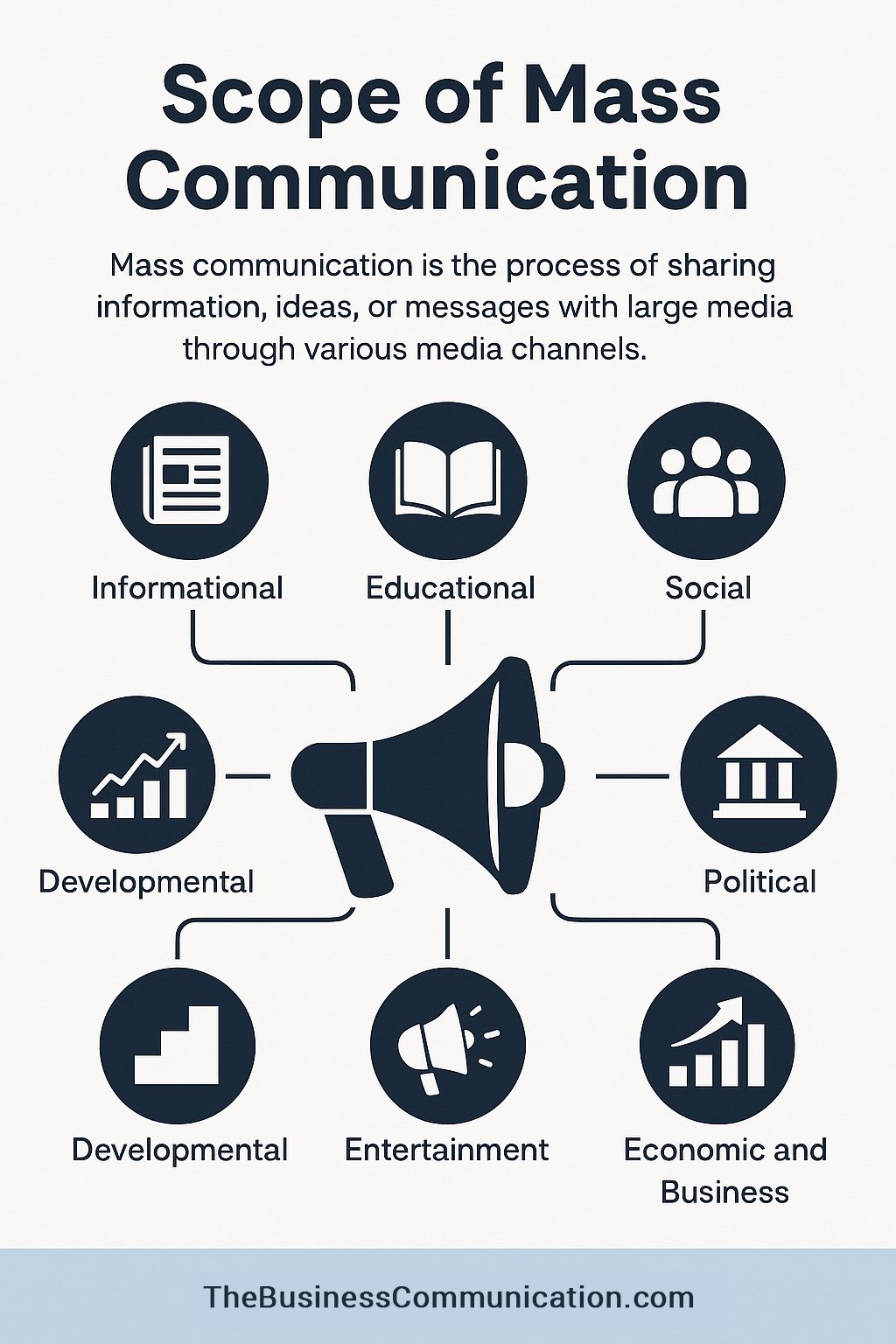
The scope of this field is expanding every day. It started with simple letters. Now, it includes Virtual Reality (VR) and Artificial Intelligence (AI).
Where is it going next?
- Hybrid Models: Traditional TV and newspapers are merging with digital apps.
- AI Integration: Algorithms will personalize news and entertainment specifically for you.
- Citizen Journalism: Ordinary people are becoming the reporters, using their phones to break news faster than big networks.
Despite the challenges of fake news and privacy, the future looks bright. The demand for clear, engaging communication will never go away.
Conclusion
Mass communication is the nervous system of modern society. It informs us, protects us, and entertains us.
It relies on a complex process involving sources, gatekeepers, and technology. From the credibility of print to the speed of digital, every channel plays a vital role.
For business leaders and students, mastering this field is essential. After all, in a world full of noise, the person who communicates best is the one who wins.
So, the next time you watch a video or read a blog, look closer. You will see the machine at work.
Frequently Asked Questions
1. What are the 4 primary functions of mass communication?
They are Surveillance (monitoring news), Correlation (interpreting facts), Cultural Transmission (education), and Entertainment (escapism).
2. What are the main types of mass media?
The three main types are print media (newspapers, magazines, books and journals), broadcast media (radio and television) and digital media (websites, social media, podcasts and streaming services).
3. Is social media a type of mass media?
Yes. It is usually counted as digital mass media because one post can reach a large audience. Unlike traditional media, it is many-to-many, and most of its content is created by users.
4. How does digital media differ from traditional media?
Digital media is interactive and allows for instant feedback. Conversely, traditional media like TV or print is mostly one-way and has delayed feedback. This real-time feedback lets organizations adjust content and respond to their audience much faster.
5. Who are the gatekeepers in mass communication?
Gatekeepers are the people or systems that control what information is published. This includes editors, producers, and increasingly, social media algorithms. They judge content on newsworthiness, accuracy, legal risk, audience interest and editorial standards, while algorithms filter it by predicting what will engage users, often without human review.
6. Why is mass communication important for business?
It allows businesses to build brand awareness, launch products to a global audience, and manage their reputation through PR and advertising.
7. Is print media dead?
Not at all. In fact, print media still holds high credibility. It is evolving into niche magazines and hybrid digital formats.
8. Can a small business use mass communication strategies effectively?
Yes, but differently than large organizations. Small businesses leverage digital channels like social media and podcasts instead of TV or print. The key is choosing the right channel for your audience and accepting that you may reach thousands, not millions. Your advantage is authenticity and agility—you can respond to feedback faster than traditional media giants.
4 Comments
Help me
It is a very informative article.I like your article very much. I want to share my website details with you. Please give me some information to increase performance like as your website.
Your research on mass communication has really helped. Thank you very much.
2004 & Barling. Your research has procured the greatest deer velvet extract and imported it.